Flying Scotsman had a dismal year in 2024 when she remained virtually stationary, spending most of the year on static display at the National Railway Museum (NRM) sites in York & Shildon. Last year (2025) she was a little more active: 2 x single day mainline excursions and 4 x multi-day outings on heritage railways. The rest of the time she was again, on static display.
Initially her programme for 2026 didn’t look much different, but thankfully more and more main and heritage line excursions have been scheduled as the year progresses…
UPDATE – 09/09/2026: Just Go! Holidays (JGH) have chartered Flying Scotsman round trips on the Swanage Railway in Dorset this October. Their 2-day package includes coach travel to Dorset and an overnight stay in Bournemouth.
(See previous updates on Page 2)
Flying Scotsman Programme for 2026
| Date | Host | Activity |
|---|---|---|
| 01-08 Jan | NRM | On static display at York |
| 14 Feb | VTR | Flying Scotsman will haul three Valentine’s Shakespeare Express trains on 2hr return trips from Birmingham to Stratford-Upon-Avon, with brunch, afternoon tea or dinner service in Pullman carriages. |
| 18-20 Feb | VTR | Five one hour trips daily over half-term from Birmingham Moore Street station. Slightly odd this one; the outbound trip is diesel-hauled, then FS takes over for the return journey. |
| 21 Feb | VTR | An addition to the programme – Flying Scotsman will repeat Vintage Trains’ Shakespeare Express Valentine’s Day excursions. Three trains on 2hr return trips from Birmingham Moore Street/Snow Hill to Stratford-Upon-Avon, with brunch, afternoon tea or dinner service in Pullman carriages. |
| 10, 11, 12, 17, 18 & 19 Mar | WCL | FS will be on static display and open for footplate tours. |
| 13, 14, 15, 20 & 21 Mar | WCL | FS will be running return journeys up and down the Watercress Line’s 10 mile track from Alresford to Alton and back. There are premium dining tickets for breakfast and afternoon tea on board, and ordinary passenger tickets. WCL will also be operating trains taking passengers from Ropley station and Alton to join FS at Alresford. |
| 28 Mar – 24 Apr | NRM | Flying Scotsman will be on static display at the National Railway Museum, York. |
| 16,17 May | GCR/FEE | FS will be on static display and available for footplate visits over the weekend during the Nottingham Transport Heritage Centre model railway exhibition, at the GCR Ruddington station. FEE are handling bookings. |
| 20-28 May | GCR/FEE | FS will be available for footplate visits at Ruddington on 20th, 21st, 26th, 27th and 28th May. FEE are handling bookings. |
| 23-31 May | GCR/FEE | Flying Scotsman will haul multiple trips on 23rd, 24th, 25th, 30th and 31st May. FEE are handling bookings. |
| 03-12 June | ELR/JGH | FS will be on static display on 3rd(H), 4th(B), 10th(H), 11th(B) and 12th(B) June. At (B)ury or (H)eywood stations. |
| 05-14 June | ELR/JGH | FS will haul trains from Bury to Rawtenstall on 5th(D), 6th(D) & 7th and then on 13th(D) & 14th June. (D=Dining). |
| 20 Jun | DCC | Flying Scotsman will be on static display at the Wabtec UK Doncaster rail engineering site, Doncaster. |
| 02 – 31 Aug | LOC | Flying Scotsman will be on static display or running along the 0.6 mile (1 km) track at the National Railway Museum’s other site ‘Locomotion’, Shildon. |
| 16 Sep | FEE/VTR | Derby – York. Outbound journey (Dep Derby: 10.15 Arr York: 13.10) hauled by classic diesel locomotive. Return journey (Dep York: 18.30 Arr Derby: 21.40) hauled by Flying Scotsman. |
| 16 Sep | FEE/VTR | York – Scarborough. Outbound (Dep York: 13.25 Arr Scarborough: 14.30) Return journey (Dep Scarborough: 17.10 Arr York: 18.15 ) Both journeys hauled by Flying Scotsman. |
| 19 Sep | FEE/VTR | Birmingham (Stourbridge Junction Station) – Bristol. Outbound journey (Dep Stourbridge: 07.50 Arr Bristol 10.50). Return journey (Dep Bristol: 19.40 Arr Stourbridge 22.30) Both journeys hauled by Flying Scotsman. |
| 19 Sep | FEE/VTR | Bristol – Minehead. Outbound journey goes to Bishops Lydeard where the train joins the West Somerset Railway (heritage line) to Minehead. (Dep Bristol: 11.05 Arr Bishops Lydeard: 14.40) Return journey (Dep Bishops Lydeard: 16.40 Arr Bristol: 19.55) Flying Scotsman will haul both journeys to and from Bishops Lydiard, and will share some of the journey on the West Somerset Railway with a diesel. |
| 23 Sep | FEE/VTR | Chesterfield – York. Outbound journey (Dep Chesterfield: 09.00 Arr York:11.25) hauled by Flying Scotsman. Return journey (Dep York: 18.10 Arr Chesterfield: 20.15) hauled by a diesel locomotive. |
| 23 Sep | FEE/VTR | York – Newcastle. Outbound journey (Dep York: 11.35 Arr Newcastle: 13.20) and return journey (Dep Newcastle: 16.15 Arr York: 18.00) both hauled by Flying Scotsman. |
| 14 Oct | FEE | Midlands – York A return trip from from Coleshill Parkway in the West Midlands. The train’s classic carriages will be hauled by a vintage diesel on the outbound journey (3hr 45m) to York in the morning. Then there’s a few hours free time before passengers rejoin the train at 18.05 for the return journey hauled by Flying Scotsman. |
| 17/18 Oct | FEE | Didcot – Newbury Two return trips on each day (Sat/Sun) through Oxfordshire & Wiltshire from Didcot Parkway to Newbury Racecourse station, hauled by Flying Scotsman. The morning trip (already sold out on both days) departs 11:00, arriving at Newbury Racecourse 11:45. There’s a 30 minute stopover before departing on the return journey at 12:15, arriving back at Didcot 15:05. Then there’s a quick 20 min turnaround for Flying Scotsman before she sets off again at 15:25 for the second trip of the day, arriving at Newbury Racecourse 16:30. This time the stopover is only 10 mins. She departs Newbury Racecourse at 16:40, arriving back at Didcot 19:20 |
| 23 Oct – 01 Nov | SR/JGH | Flying Scotsman will be visiting Swanage Railway, which has 5½ miles of track between Norden & Swanage. She’ll be on static display at Swanage Station on 23, 26, 30 & 31 October. She will haul trains on 24, 25, 27, 28, 29 October and 1st November, with JGH chartering her on two days: 27/28 Oct. Tickets available on the SR & JGH websites. |
| 13-15 Nov | FEE | Darlington – Stanhope An excursion along the main line from Darlington to Bishop Auckland and then on to the Weardale Railway (heritage line) to Stanhope, hauled by Flying Scotsman. There are two trips each day. The first departs Darlington 08:40, arriving at Stanhope 10:15. Then the return journey departs Stanhope 11:15 arriving back into Darlington 12:50. The second departs at 13:40, arriving at Stanhope 15:15. Then the train leaves Stanhope 16:15 and arrives back into Darlington 17:45. The total return journey is 60 miles. |
|
A1 = A1 Steam Locomotive Trust |
NRM = National Railway Museum |
Flying Scotsman – the historic locomotive
Built in 1923 for the London and North Eastern Railway (LNER) at Doncaster Works, Flying Scotsman was designed by Sir Nigel Gresley as part of the A1 class – the most powerful locomotives used by the railway. She was quickly used by LNER for their long-distance express services, notably on the long-running (62 yrs) daily 10.00am London to Edinburgh ‘Flying Scotsman’ train service after which she was named.
She still holds two world records: the longest non-stop run at 441 miles (8 Aug 1989 in Australia), and the first steam locomotive officially authenticated at reaching 100 miles per hour (30 Nov 1934 in the UK).
Flying Scotsman is owned by the National Railway Museum (part of the Science Museum Group). In June 2024 a new operator, Northern Steam Operations Limited (NSOL), was contracted to manage and run Flying Scotsman for 7½ years to 31 January 2032.
With conservation in mind, the new contract specified a reduced programme with up to 30 days of static display, 15 heritage railway operating days and 20 main line excursion days each year. It was not clear what she would be doing for the remaining 300 days.
The Flying Scotsman numbers game…
It’s easy to get confused over the identity of the ‘Flying Scotsman’ because she is sometimes referred to by different engine numbers.
When she came out of the Doncaster Works on 24th Feb 1923, she was Engine No. 1472.
Within a year she was re-numbered No. 4472, given the name ‘Flying Scotsman’, and introduced to the public at the 1924 British Empire Exhibition.
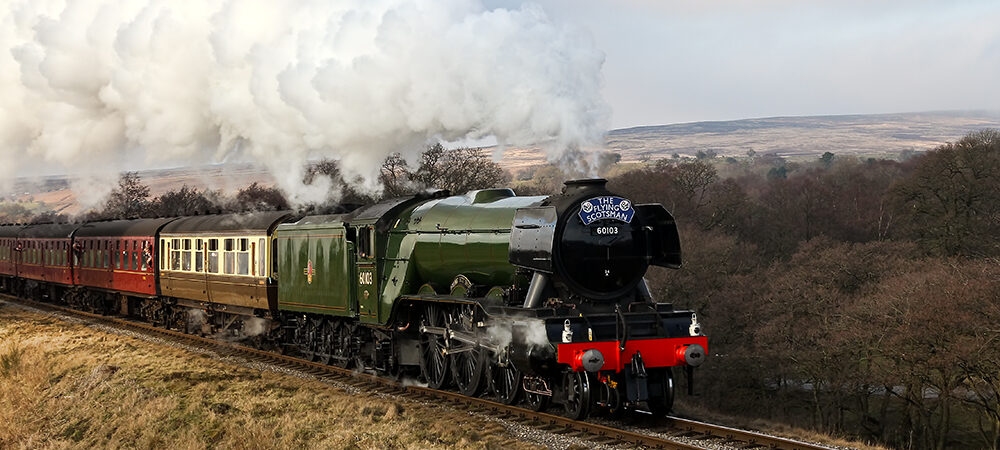
Then, in 1948, when the independent rail companies were nationalised and merged into British Railways, she became No. 60103.
Image: Flying Scotsman on the North Yorkshire Moors Railway in 2016 – Charlie Jackson (CC-BY-2.0)
Pages: 1 2