 By
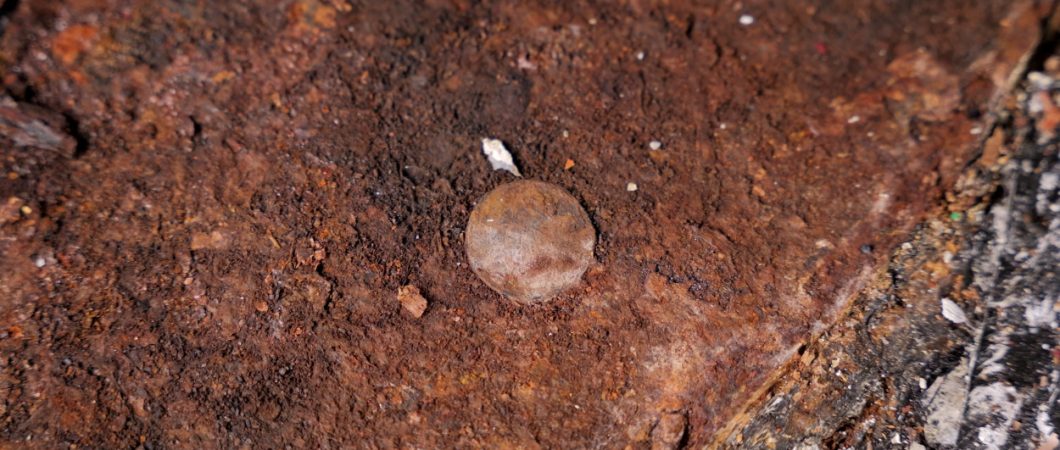
By When HMS Victory‘s masts were removed at the end of April*, six 19th century coins and tokens were discovered under the foremast.
Placing coins on the mast step before the mast is lowered, was a long-time maritime tradition intended to bring good fortune**. So it might have been expected that there would be a coin under HMS Victory‘s foremast, but to find six such tokens was, as Andrew Baines, Executive Director of Museum Operations at Royal Navy Museums, said: “an extraordinary surprise.”
Of course, they’ve spent the last 132 years crushed under the weight of approximately 50 tonnes of masts, yards and rigging above them, so they are not looking quite as shiny as they were when placed there! Prolonged pressure and corrosion left them heavily degraded and difficult to identify, but that hasn’t stopped Royal Navy Museums conservators.
Once they had been carefully cleaned with brushes, wooden skewers and tweezers, they were scanned using X-radiography to see both sides of the coin beneath the corrosion. Five of the coins date closely to the period when HMS Victory‘s foremast was last stepped in 1894. However, one coin dated from 1835 and proved to be a Canadian token, rather than currency, with an intricate image of a ship stamped or struck on it.
The team has now been able to identify the six finds as:
- 1892 one penny, Queen Victoria “bun head” portrait
- 1890 one penny, Queen Victoria “bun head” portrait
- farthing, dated 1882
- 1890 one penny, Queen Victoria “bun head” portrait
- 1890 halfpenny, Queen Victoria “bun head” portrait
- 1835 Prince Edward Island “Ships, Colonies and Commerce” token – Issued in what is now Canada, the token carries the words “Ships, Colonies and Commerce”, making it a fitting object to have been placed beneath the mast of one of the world’s most famous warships.
Andrew Baines added, “The 1835 Prince Edward Island token is one of the most intriguing finds. Its inscription, ‘Ships, Colonies and Commerce’ – a slogan closely associated with the maritime and imperial trade networks of the 19th century – reflects the world in which HMS Victory served and suggests these coins may have been chosen for symbolic as well as practical reasons.
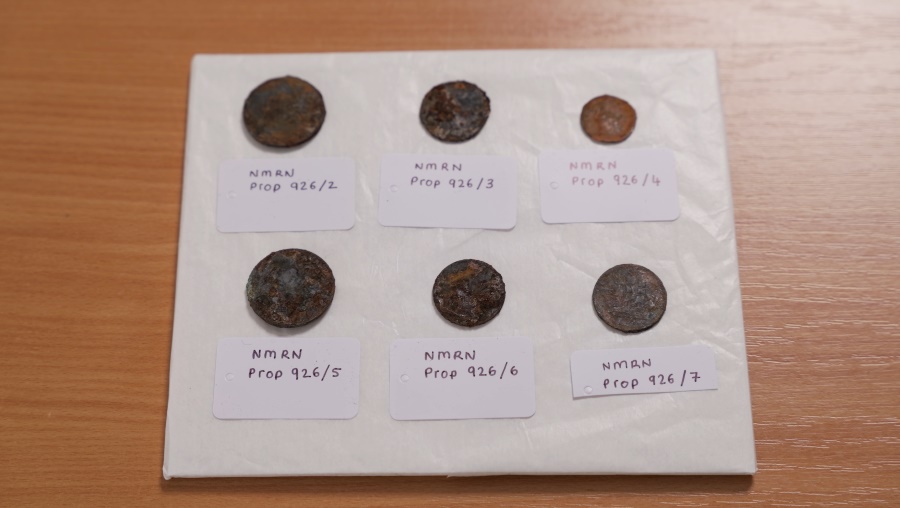
The six newly discovered coins and token, together with an earlier coin discovered beneath Victory’s main lower mast section, will go on display in the Victory Gallery at Portsmouth Historic Dockyard from 23 May and will remain on display throughout the summer.
Other Portsmouth Posts
| Portsmouth Historic Dockyard | HMS Victory & Nelson |
| HMS M33 | Mary Rose |
| Submarine Museum | Explosion! |
| HMS Warrior | D-Day Story |
| Visiting Portsmouth | |
* HMS Victory’s remaining masts are coming down
** Of course, these days, with few sailing ships being built, the coin tradition is recreated in the keel laying ceremony for new ships, where coins for good luck are placed under the first section of a new build. I have attended a couple myself. The downside is that the coins are not there for long. When the ship is floated, they get removed and sometimes welded on the inside, or more usually, mounted in a picture frame which is kept on board or in the shipyard offices.
PS. Un-noticed by me (and I suspect , many people) The National Museum of the Royal Navy has rebranded itself into Royal Navy Museums.