 By
By The Fehmarnbelt Tunnel is a major European civil engineering project to lay an 18 km (11.2 mile) road and rail tunnel under the Baltic Sea between Germany and Denmark.
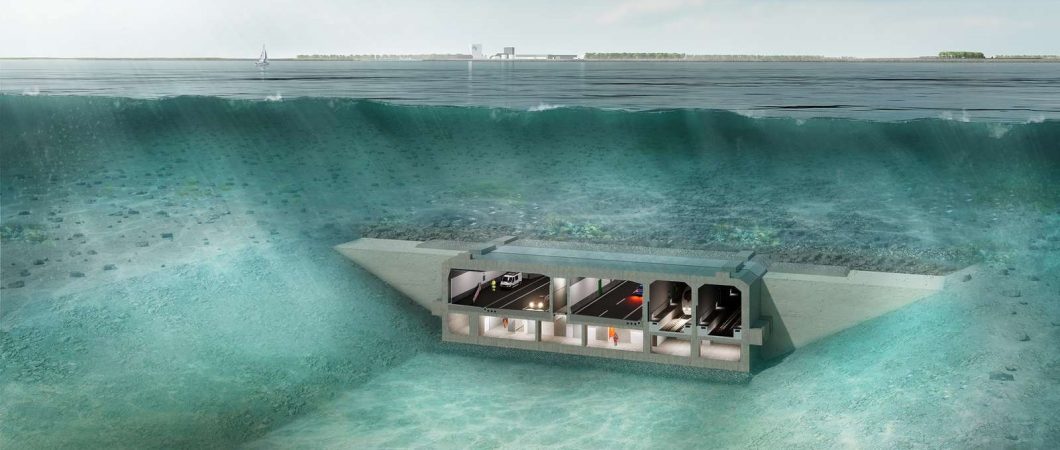
You notice I said “lay” and not “dig”. This amazing tunnel will be laid in sections in a giant trough dredged out of the seabed, and then covered over. At its deepest point, it will be 40 metres (131 ft) under the sea.
Each one of the 89 pre-fabricated concrete tunnel sections is 217 metres (712 ft) long and weighs more than 73,500 tonnes. The sections are divided into five tubes – two for the future motorway (two lanes each), two for the railway, and one for technical services.
Why build a €7/£6.1 billion tunnel?
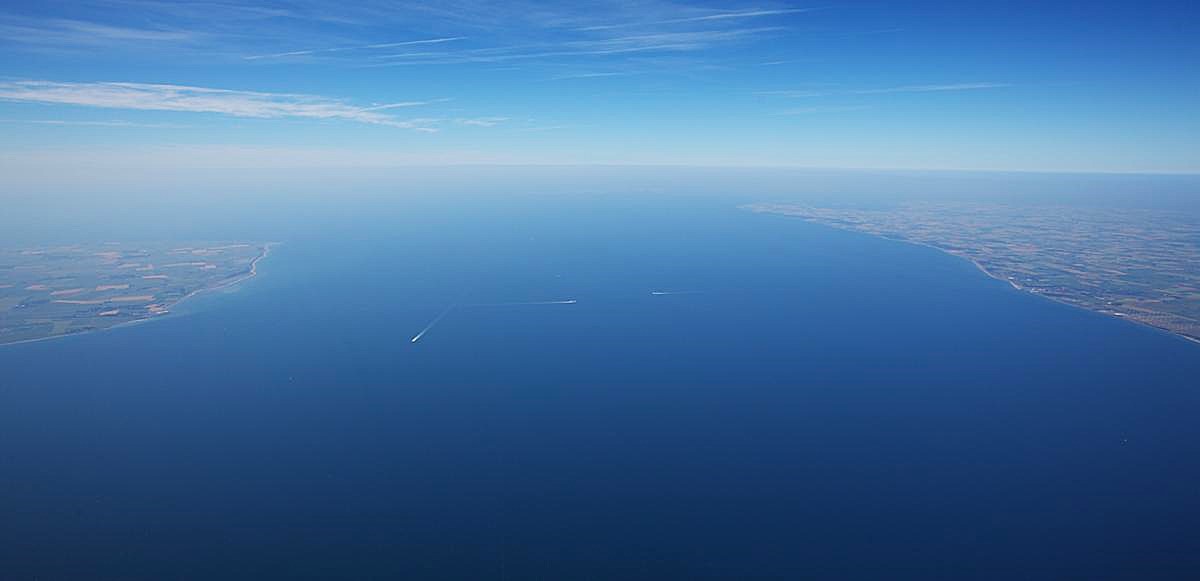
Well, at a local level the tunnel will provide an alternative to the existing 45 minute ferry service across the strait. When open, in 2029 (fingers crossed), it will take car drivers 10 minutes to cross, and only 7 minutes for train passengers.
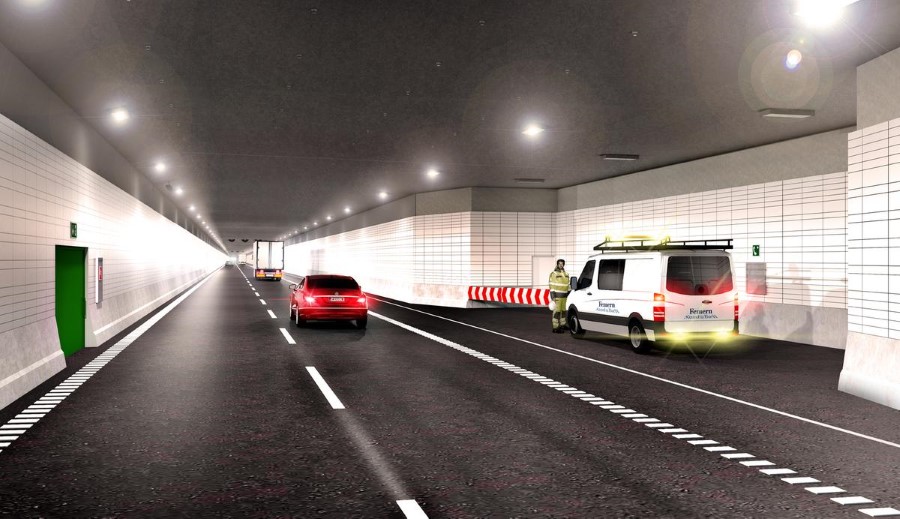
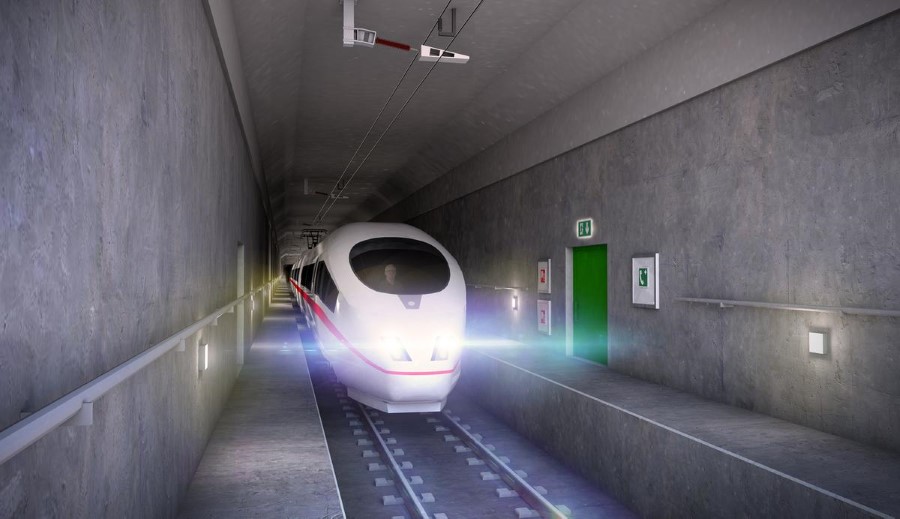
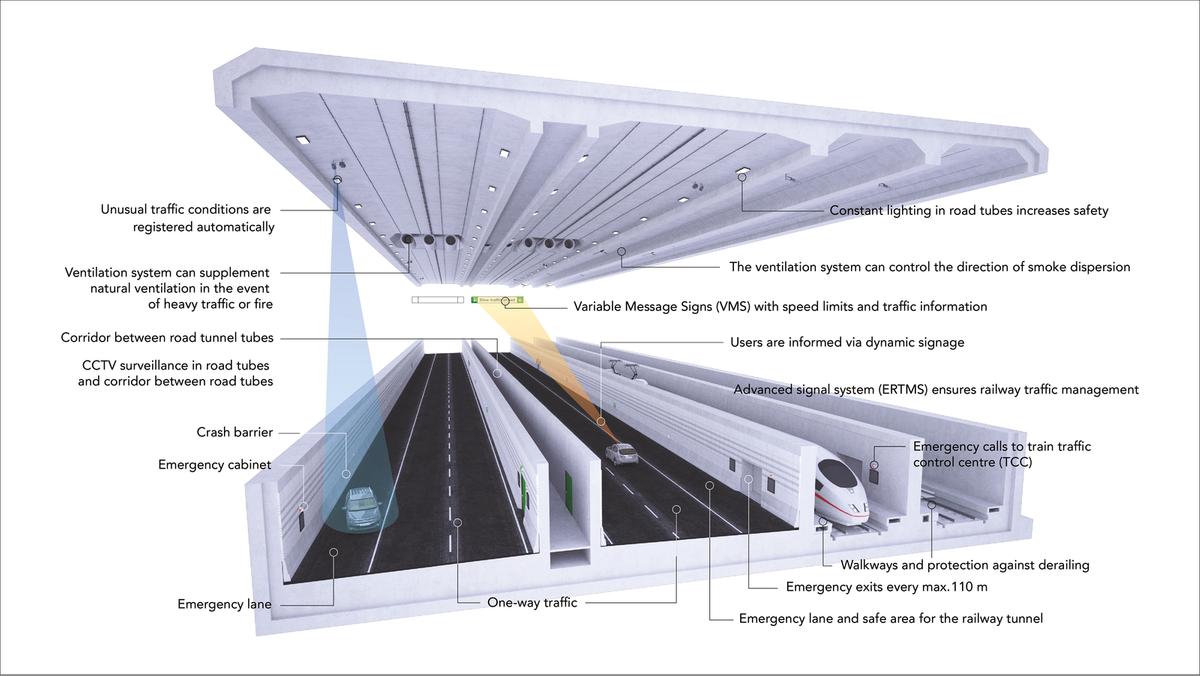
But there’s a larger strategic purpose. The tunnel is considered to be a key component of the wider pan-European transport infrastructure.
For example, most people fly between Copenhagen and Hamburg. If they go by train, it takes around 4½ hours. When the tunnel is open, it’ll take 2½ hours, making rail competitive with air. The same journey by car will be about an hour faster.
On a larger scale, freight traffic between Scandinavia & Germany via Denmark can currently use the ferry across the Fehmarnbelt or take longer land routes via bridges between Zeeland, Huenen and Jutland. The tunnel will shave 160 kilometres off the land route.
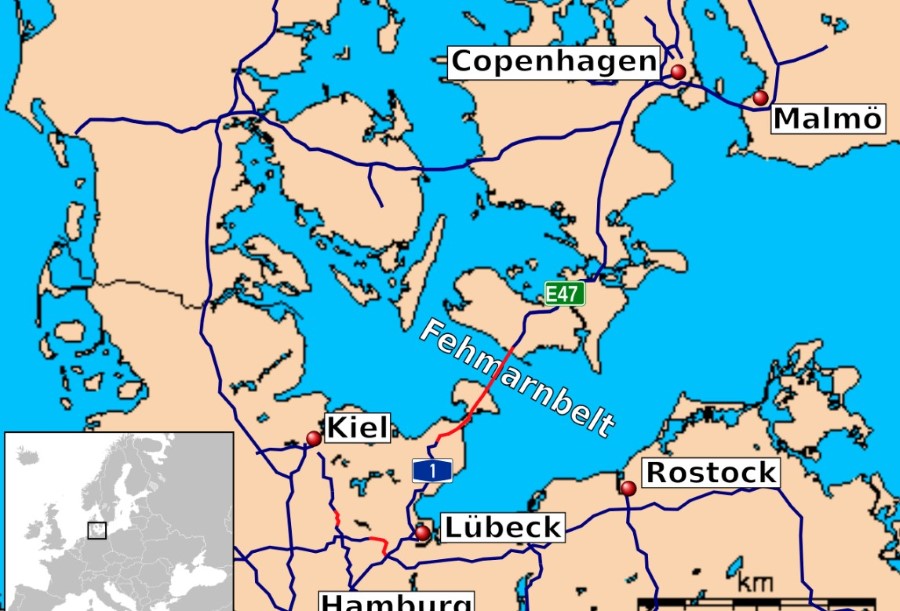
Talking to CNN in 2022, Michael Svane of the Danish Industry Confederation said he believed the tunnel will also benefit businesses outside of Denmark. “The Fehmarnbelt Tunnel will create a strategic corridor between Scandinavia and Central Europe. Upgraded rail transport means more freight moves from road to rail, making transport more climate-friendly. We see cross-border connectivity as a tool for creating growth and jobs, both locally and nationally”.
The (brief) history of the Fehmarnbelt Tunnel project
The project started back in 2008 when Denmark and Germany signed a treaty to build the tunnel between Rødby on the Danish island of Lolland and Puttgarden on the German island of Fehmarn.
Of course that was the easy bit. It took another ten years just for the geotechnical and environmental impact studies to be carried out, legal objections to be processed* and the necessary legislation to be passed by both countries. Only then could work begin – with a digital ground-breaking ceremony held on 1 Jan 2021** because the planned real-life event was off the cards thanks to COVID, which had already delayed the project.
Since then it’s been a lot of work! All preparatory.
In order to prepare for dredging the channel and building the tunnel sections, they had to build large harbours with breakwaters on both coasts of the Fehmarnbelt, with construction villages and support infrastructure.
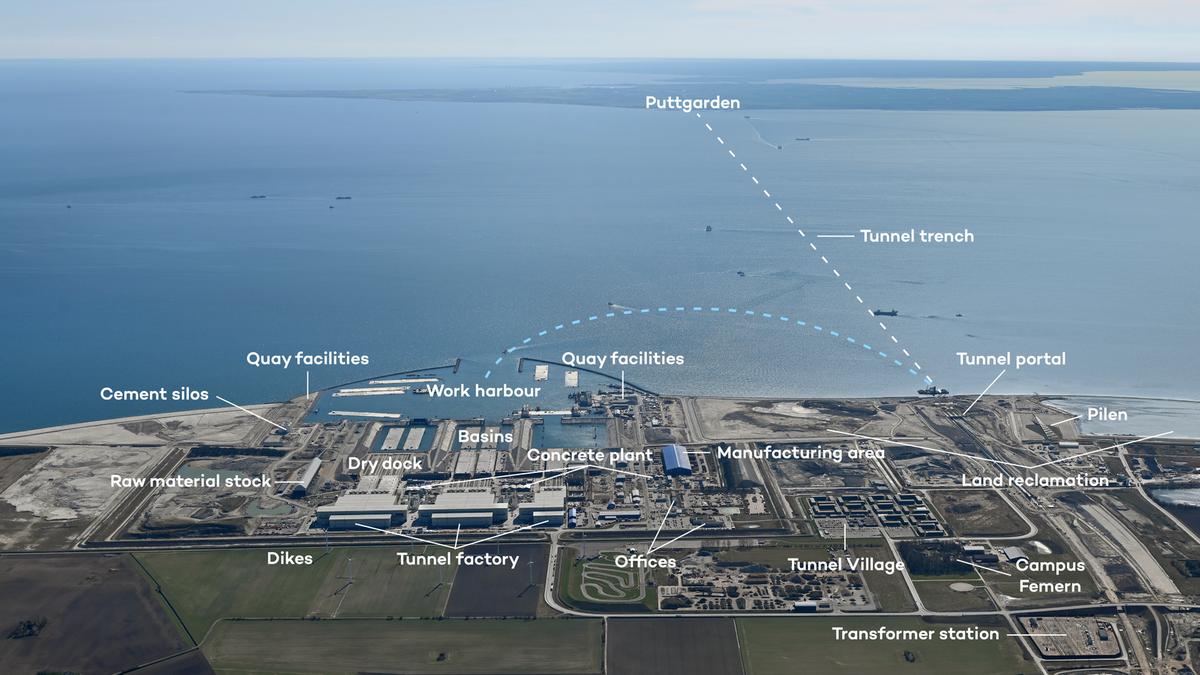
While that was going on, the giant concrete works that would fabricate the tunnel sections had to be built, together with the huge locks and basins needed to float the sections and store them. Meanwhile, work began on the entrances (“portals”) to the tunnel, and the road and rail links*** needed to connect them on both sides of the Fehmarnbelt.
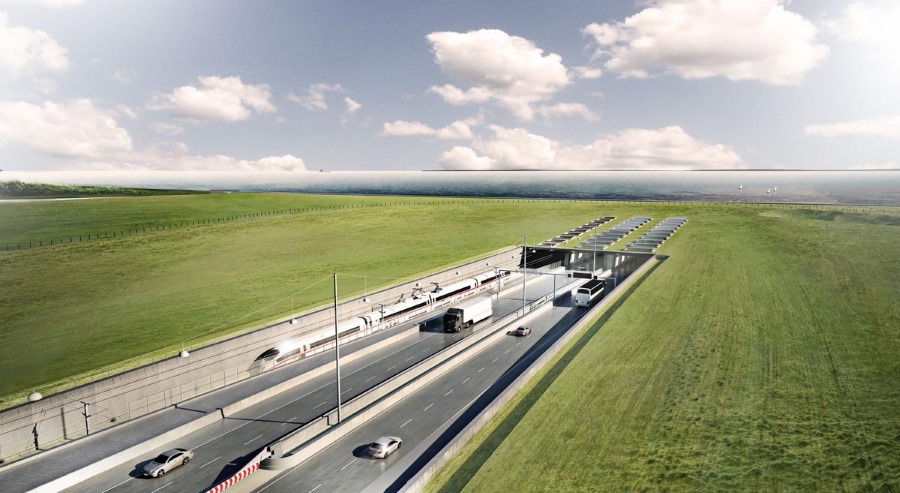
By May 2022 the channel dredging had reached the halfway mark. By mid-April 2024 it was complete. Most of the 19m cubic metres of soil dredged from the seabed is being used to reclaim land and create new nature reserves, reefs, and recreational areas around Rødbyhavn and on Fehmarn.
Construction of the concrete factory at Rødbyhavn for the fabrication of the tunnel sections through six production lines, began in the summer of 2021, and was completed two years later. The first tunnel section emerged from the factory in December 2023. It is expected that the factory will be producing tunnel sections till 2027.
There was one, perhaps unforeseen, aspect of the operation…
During investigations of the seabed in and around the tunnel route in the spring of 2021, they discovered an unexploded WW2 depth charge on the Danish side of the Fehmarnbelt and further unexploded munitions in both the Danish and German waters. The latter were salvaged and made safe, but the 125kg depth charge had to be blown up in a controlled explosion in October 2022.
As a sensitive natural area for marine life (some of the legal objections to the tunnel centred around potential harm to marine life) the detonation was carefully controlled to minimise impact. A so-called bubble curtain was used to keep underwater noise to a minimum, and acoustic pingers were used as deterrents to keep marine mammals, such as porpoises, whales and seals, away from the area.
So, where are we now?
See latest news: First Fehmarnbelt Tunnel Section Immersed
* In April 2015 the Danish government granted final environmental approval for the project in Denmark and authorised state-owned companies Femern A/S (a subsidiary of Sund & Bælt) and Femern A/S Landanlaeg to construct and operate the link together with associated land works in Denmark. However, it took another year and a half for the Federal Administrative Court in Leipzig to dismiss appeals brought by two environmental associations, three companies including the operator of the existing Puttgarden – Rødby ferry line (understandable) and (bizarrely), the city of Fehmarn.
** A formality. Work on the harbours had already begun nine months earlier.
*** On the German side, the rail connection from Lübeck to Puttgarden is 88 kilometres long. Work is underway upgrading the single non-electified line to a double-track extension plus electrification over 11.4 kilometres between Puttgarden and the Fehmarnsund bridge. Work on a further 55 kilometres of new construction with a two-track line running at 200km/h, should start this year. Works will be expected to begin in 2026.
On the Danish side, the 120 kilometre Ringsted-Fehmarn Railway between Ringsted and Rødby is being upgraded and modernised. To handle the traction power supply and the additional tracks, more than 100 bridges and roads will be modified.