 By
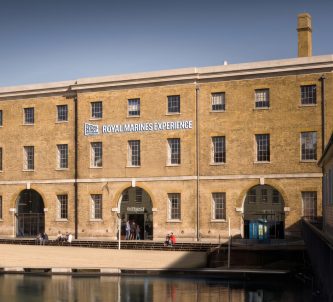
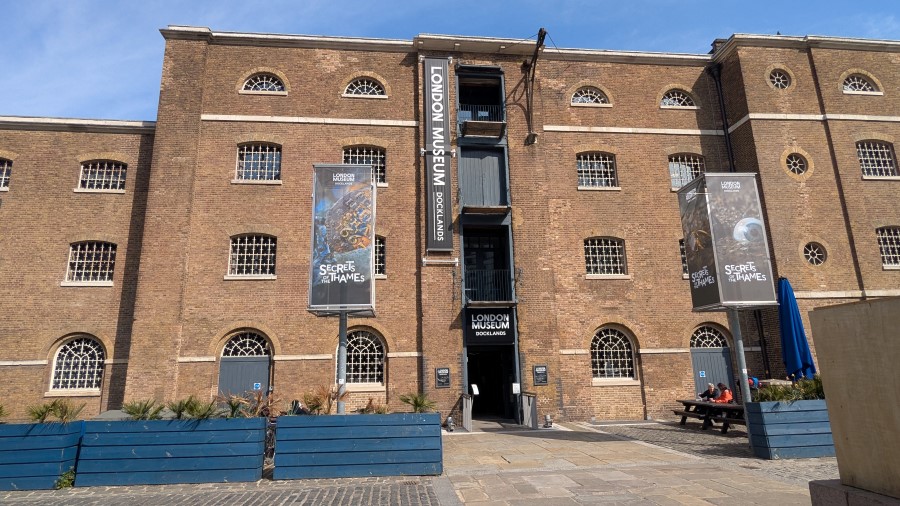
By The London Museum Docklands is a ‘must-see’ museum that tells the history of the River Thames and the growth of London’s huge port system from the first Roman settlements to the modern-day regeneration of the Canary Wharf area. It is housed, appropriately, right at the heart of docklands in the ‘No. 1 Warehouse’ at West India Quay, a Grade I listed building originally constructed in 1802.
This area was one of the first enclosed dock systems in London, designed specifically to store valuable imports like sugar, rum, and coffee from the West Indies. On the old dock wall there is a magnificent plaque commemorating the first stone laid for the dock, wharf, and warehouses on 12th July 1800. You have to love the flowery language describing the exact purpose of this expensive piece of infrastructure.
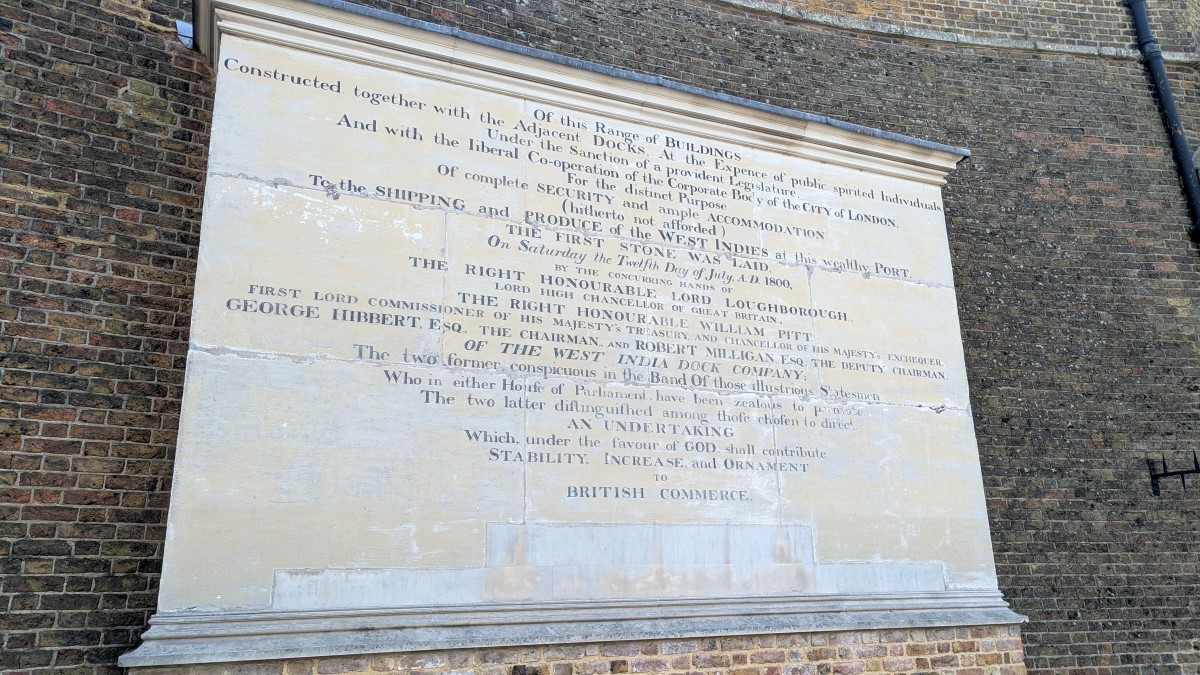
“For the distinct purpose of complete security and ample accommodation (hitherto not afforded) to the shipping and produce of the West Indies at this wealthy port” … “an undertaking , which under the favour of God, shall contribute stability, increase, and ornament to British Commerce”
Stirring stuff!
Much of the surrounding docklands were destroyed by Luftwaffe bombing in 1940, but No. 1 Warehouse survived and was eventually converted into a museum, opening its doors in 2003 as a satellite of the London Museum* which is currently relocating from its longstanding home near the Barbican to the former Smithfield Market.
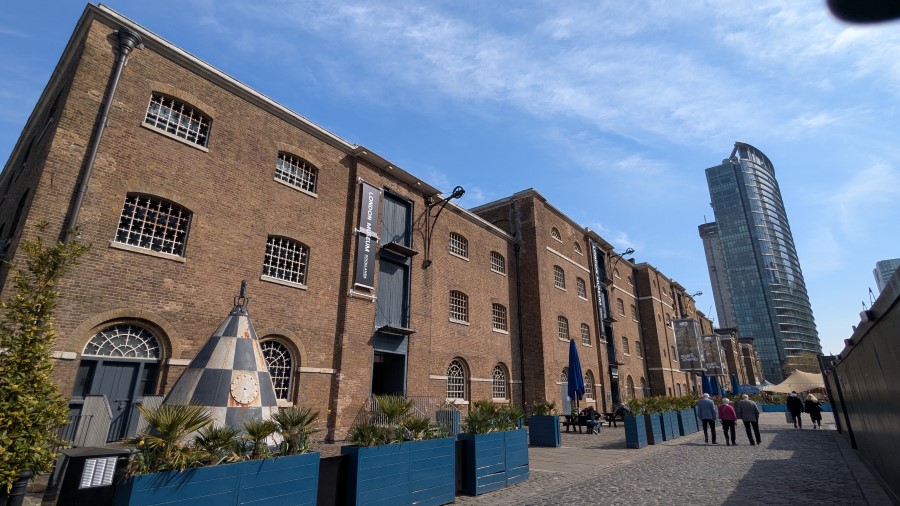
No. 1 Warehouse is a spacious building with five floors. The basement is used for schools groups & community activity spaces, and the ground floor for ticketing cafeteria and temporary exhibition space, such as the recent Mudlarking Exhibition.
The main galleries are on the top three floors and visitors are encouraged to take the lift to the top (3rd) floor and work their way down through the galleries which are laid out, loosely, in chronological order as you descend.
London Museum, Docklands – Third Floor
The third floor has three gallery areas focusing on…
The ‘No.1 Warehouse‘ itself; how it was used, what was stored, what cranes, lifts, trollies, winches and scales were used to move and weigh the goods. There’s a view over the dock from the loophole door where heavy sacks and crates were hoist up by the wall mounted crane and swung into the building. And note the cast-iron window grilles; this was a top security warehouse filled with valuable commodities.
Then the second gallery explores the ‘Trade Expansion (1600s – 1800s)‘, focusing on early merchants, sailors, and even pirates who established London’s global trading connections in, for example, silk, spices, and tea. New docks and wharves were built to accommodate the increasing trade. Much of the latter expansion was built on commodities like sugar, which leads quickly into…
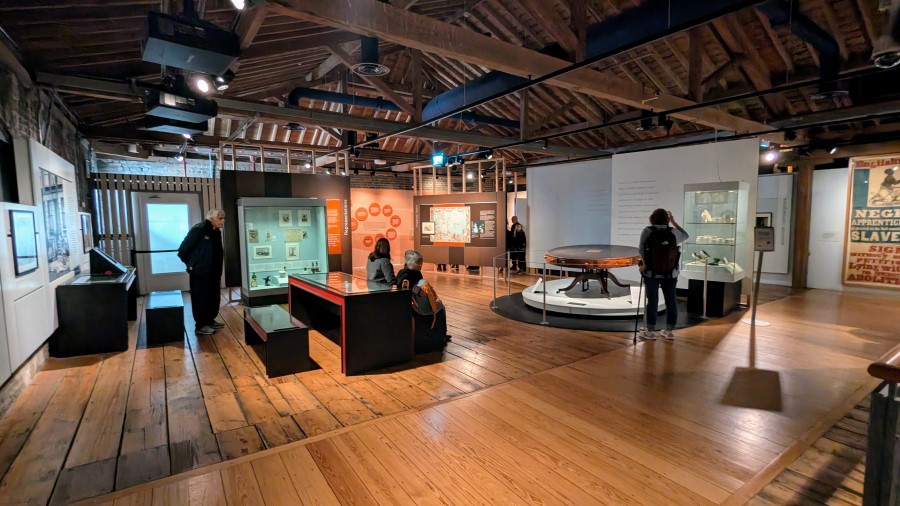
The third gallery: ‘London, Sugar & Slavery from 1600 onwards‘. It’s a chilling subject that is all bound up with the West Indies trade in sugar, coffee & cotton, and the merchants and plantation owners who profited from it.
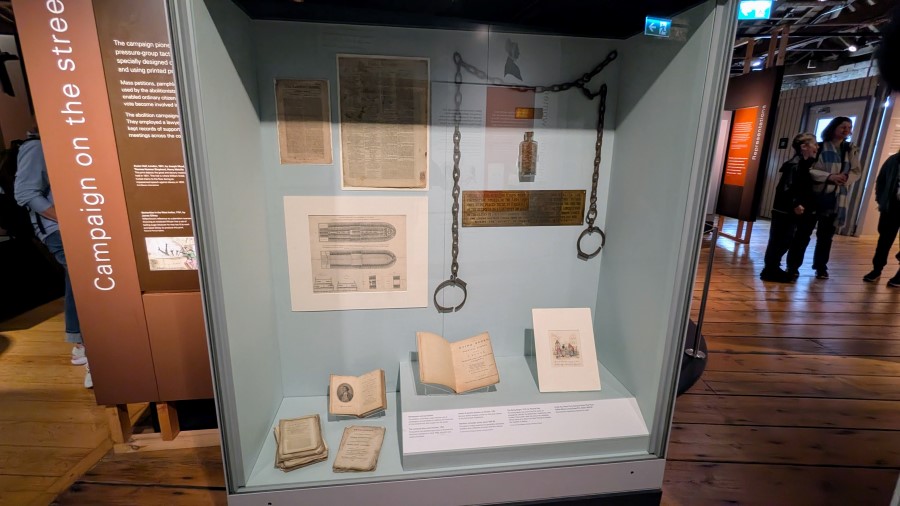
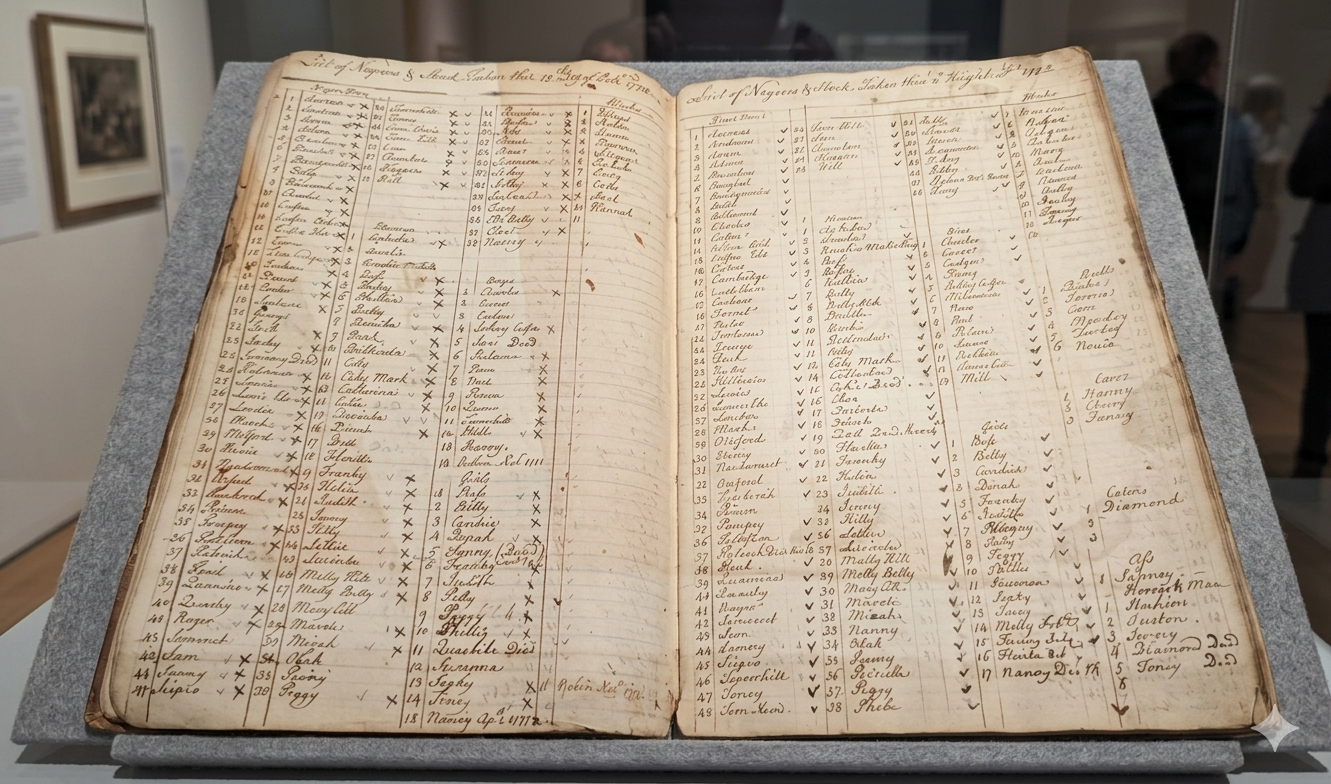
There are exhibits of manacles, shipping plans for slave ships detailing how to pack the slaves in to achieve maximum capacity, and a slave ledger keeping track of a plantation’s assets.

London Museum, Docklands – Second Floor
The second floor is bigger. It extends into the next building and has six galleries. These start with…
‘City and River 1800-1840‘ Rather like the ‘Trade Expansion’ gallery on the floor above, this gallery focuses on the growth of Docklands at the start of the century with London Docks, West India Docks, and East India Docks. Then, over the next three decades, came the accelerated growth of infrastructure powered by the new steam technology and the engineers that came with it, such as Marc Isambard Brunel’s Thames Tunnel under the river.
One display cabinet steps outside this date range, showing the Thames in its ceremonial role.
For centuries, the river was the primary route through London for everyone, including royalty in their ornate barges. We know that King John used a Royal Barge in 1215 to attend the signing of the Magna Carta at Runnymede. The river became the primary highway for monarchs, nobility and high-ranking officials in their barges which they used to commute between palaces (Windsor, Westminster, Hampton Court, Greenwich, and the Tower of London), and to hold state processions.
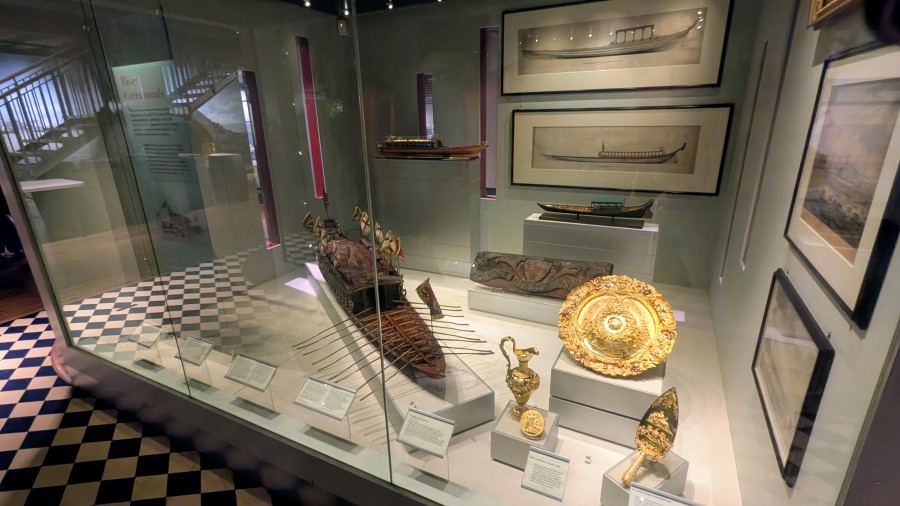
By the 15th century, the City of London Livery Companies (trade guilds) were holding elaborate water processions. The earliest account of such a procession is in the records of the Brewer’s Company for 1422, when they accompanied the Lord Mayor to Westminster.
This cabinet has a 1:11 scale model of the last City barge, supplied to the Corporation of London in 1807. Crewed by 18 Watermen, a Mate and the Barge Master, the barge conveyed incoming Lord Mayors on the annual procession to Westminster, and attended other ceremonies. It was last used for the Lord Mayor’s Procession in 1856. Around it are drawings of other ceremonial barges and gold-plated artefacts from the Livery companies.
One of the best things for grown-ups and kids is ‘Sailortown‘ a recreated labyrinth of shops, a pub, chandlers and other emporia in the dimly lit, narrow, alleyways of 1840s Wapping. Keep a tight grip on your wallet/purse!
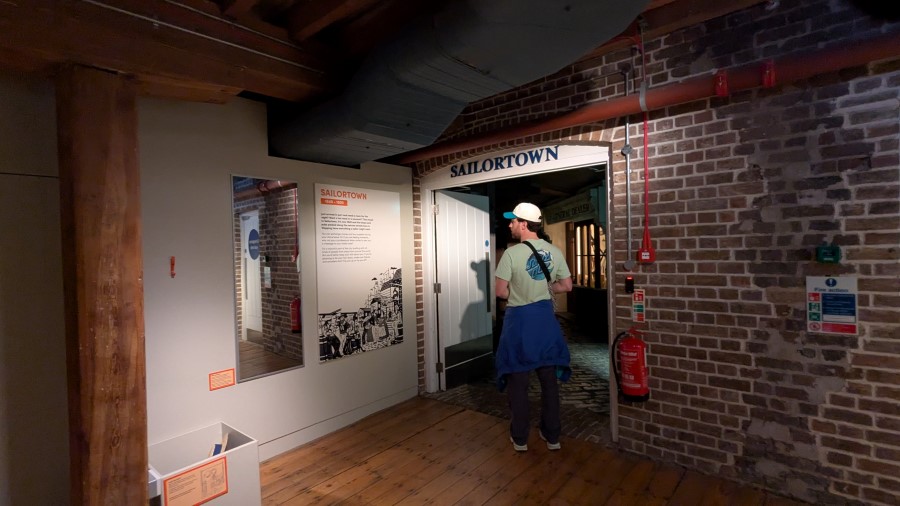
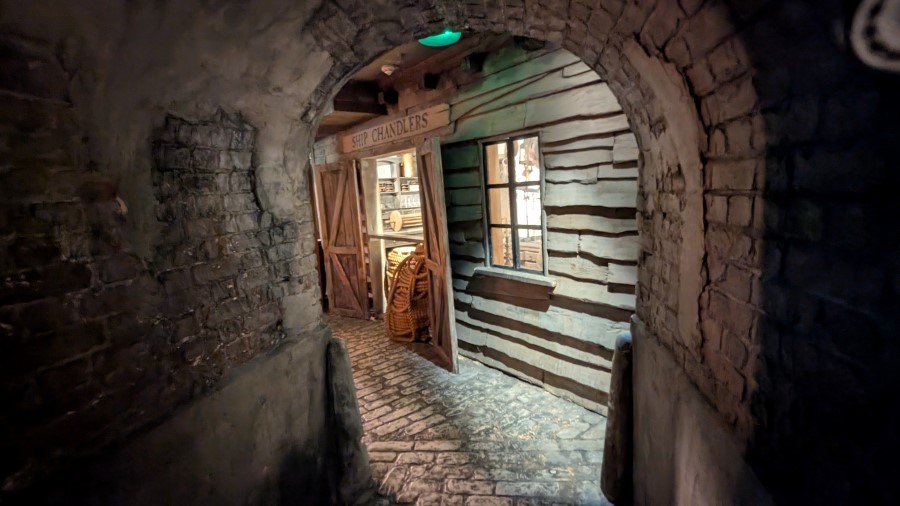
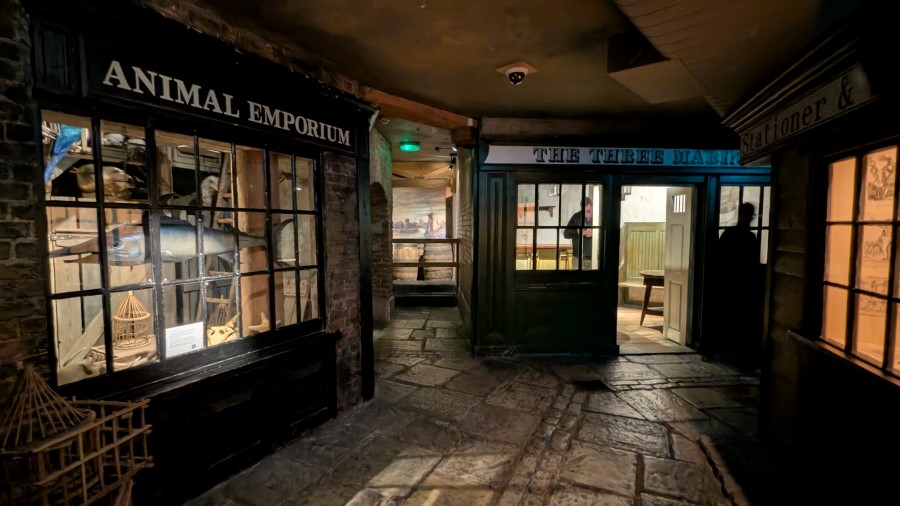
‘First Port of Empire (1840-1910)‘
This is the period when the docklands, now a wealthy centre of economic trade at the heart of the British empire, began to expand rapidly. Not just new and larger docks for the new generation of iron ships such as Isambard Kingdom Brunel’s gigantic ship, the Great Eastern, but also the shipyards and engineering works needed to build them. And other industries were drawn to this modern industrial zone such as potteries, gasworks and candle works.
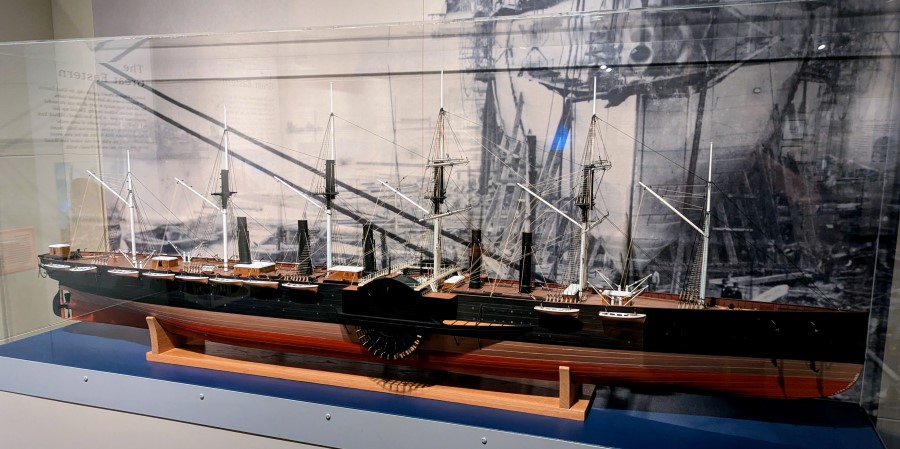
SS Great Eastern had to be big enough to carry the 15,000 tons of coal she needed to reach Australia, and have space to carry enough profitable goods. She was built at John Scott Russell’s Millwall Yard and finally launched after several attempts on 31 January 1858. This 1/96 scale model depicts her as she was 20 months later, just before her sea trials.
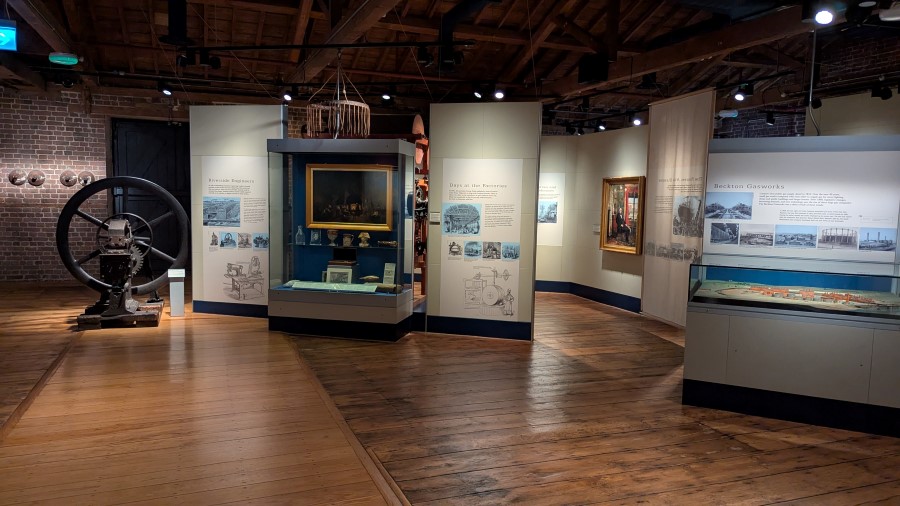
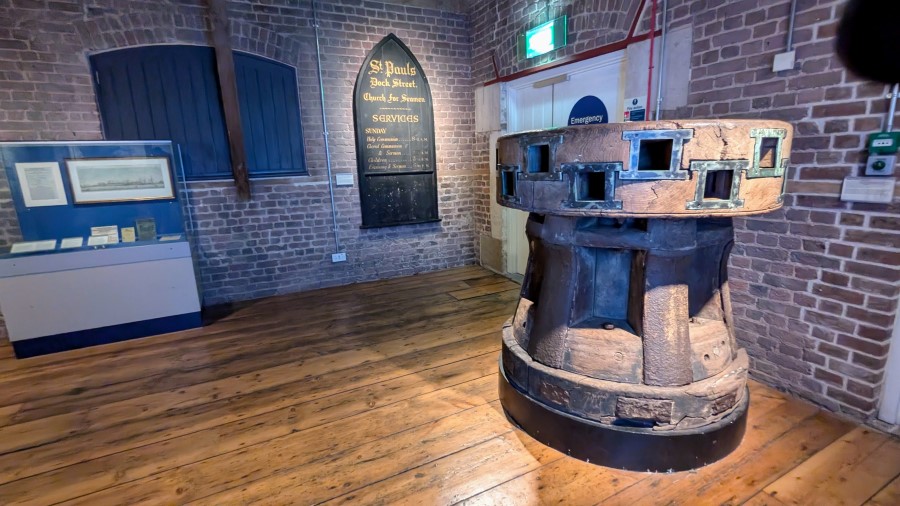
This gallery also has some original features from when the building was a busy, working warehouse, like winches that were used to hoist heavy cargo. In particular there is a large capstan dominating one corner of the gallery. It looks like – and I took it to be – a ship’s capstan for hauling an anchor and other uses. But it is a shipyard capstan built by Stockwell and Lewis in 1871. It originally came from the old dry dock at Blackwall Point, now located under the O2 Arena on the Greenwich peninsula.
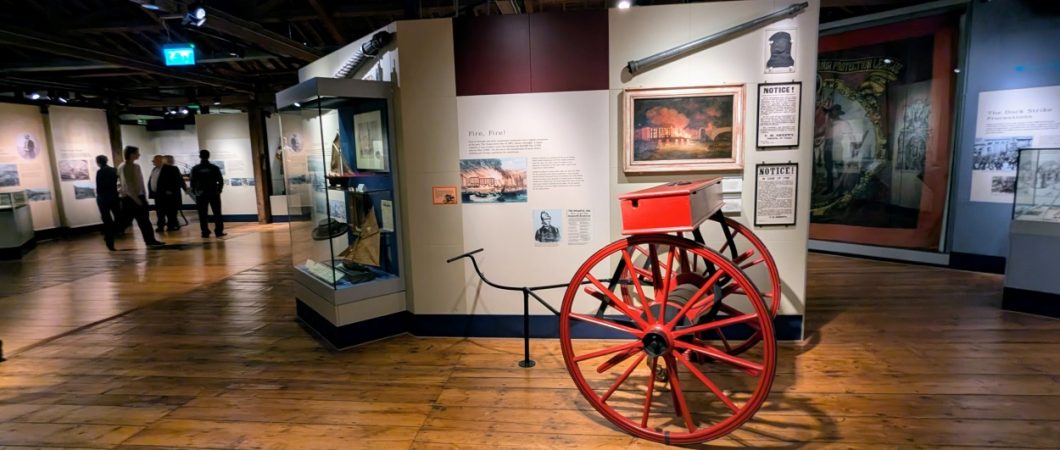
With all the goods and materials stored in warehouses, plus all the industrial activity, fire was an ever-present danger. The Tooley Street Fire of 1861 certainly focused minds. Despite restrictions on smoking and the use of candles, and detailed instructions to watchmen and dockers on what to do if fire broke out, a bale of jute caught fire in Cotton’s Wharf on a Saturday afternoon.
Fuelled by cargoes of cotton, spice, rags, oil, resin and tallow, the fire consumed some twenty warehouses. Shops and houses were gutted in Tooley Street itself, and a steamer, four sailing ships and many barges were destroyed. Fire carts like this were simply overwhelmed.
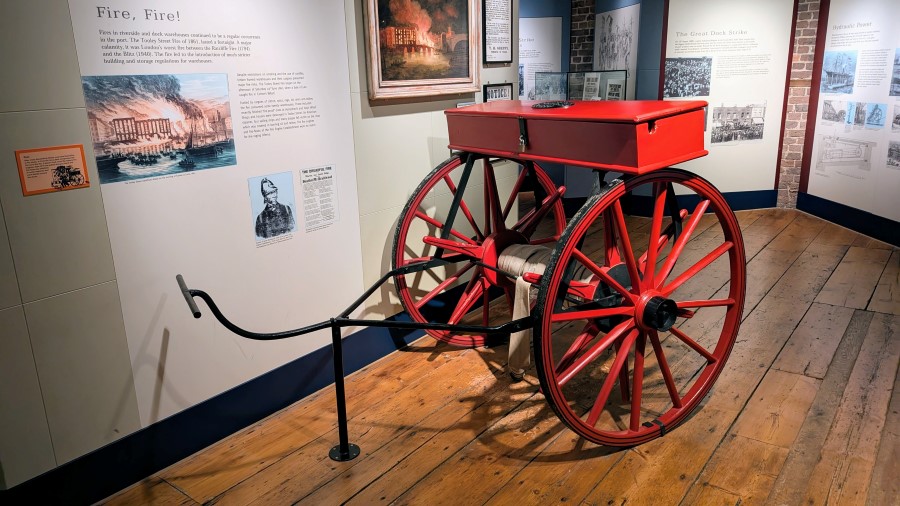
Understandably fire precautions were beefed up after that!
‘Warehouse of the World (1880-1939)‘
In many ways this gallery overlaps with the previous gallery, only here the focus is the range of goods (tea, coffee, tobacco, fruits, spices, sugar, alcohol, grain, meat, furs, leather, wool, timber, etc) streaming into London, and the range of ships, from fast clipper ships to steamships, bringing them.
There are samples of these exotic goods on display and of how they were handled, for example a tea weighing machine and a wine bottle labelling bench.
One of the glamorous clipper ships delivering goods such as wool from Australia, was the square-rigger Torrens, crewed and loved by the writer Joseph Conrad.
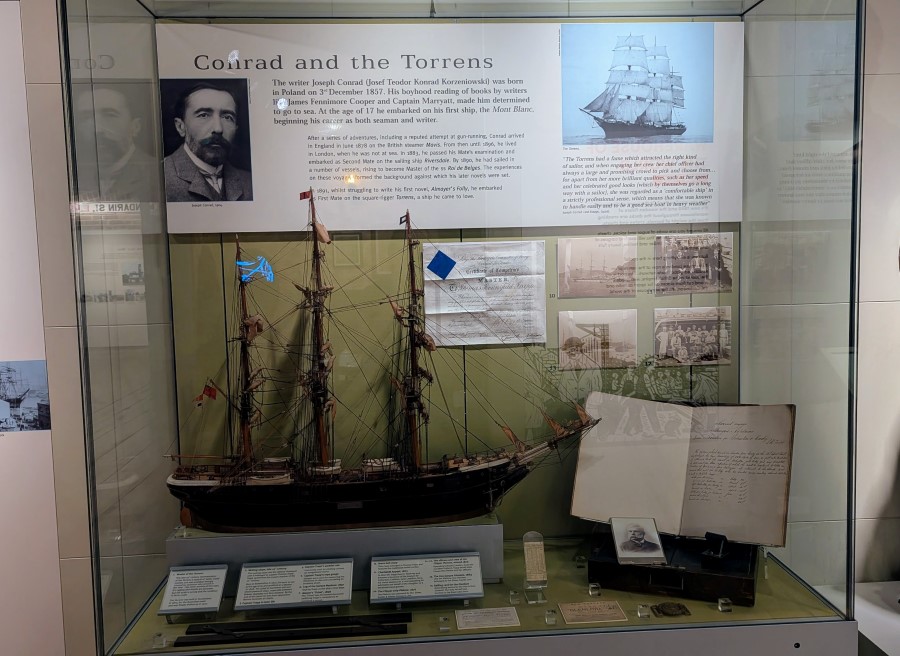
In 1891, whilst struggling to write his first novel, Almayer’s Folly, he embarked as First Mate on the Torrens.
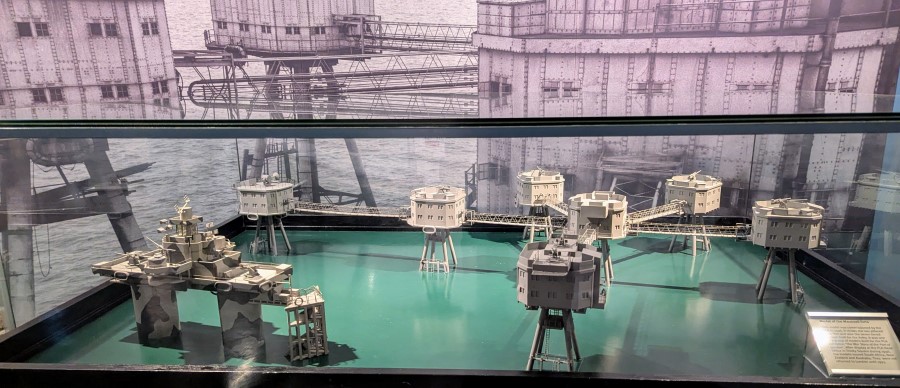
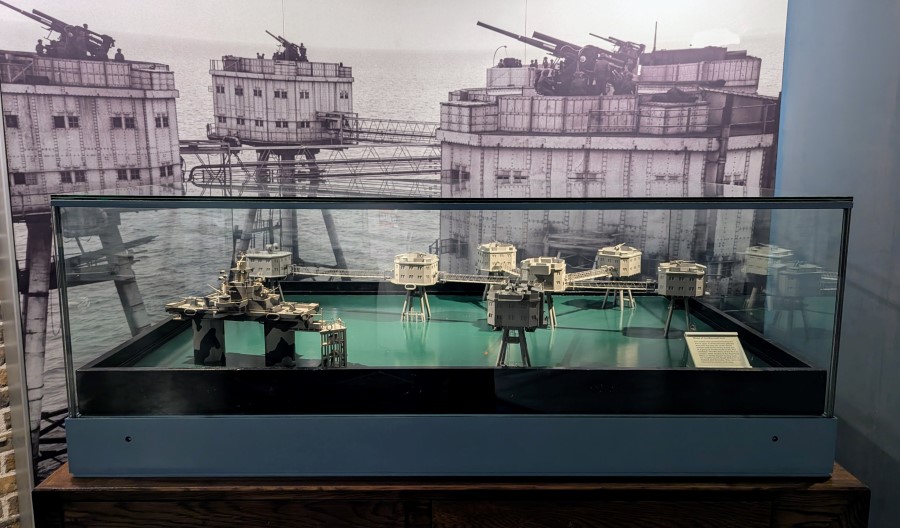
‘Docklands at War (1939-1945)‘ has some interesting exhibits including an excellent model of the Maunsell Forts; AA batteries at the mouth of the Thames.
The model, commissioned by the Port of London Authority (PLA) at the end of the war, shows the single Navy fort and the seven tower Army fort.
One fascinating info-board display features a tug boat skipper, George Sluman.
He was indentured in 1927, by the Company of Watermen and Lightermen of the River Thames**, as an apprentice to his father, and worked on the river during the 30s. When war broke out in 1939 he joined the River Thames Service Unit of the Home Guard. Later, when the Royal Navy needed experienced boatmen for D-Day, he volunteered for active service with the Navy’s Combined Operations.
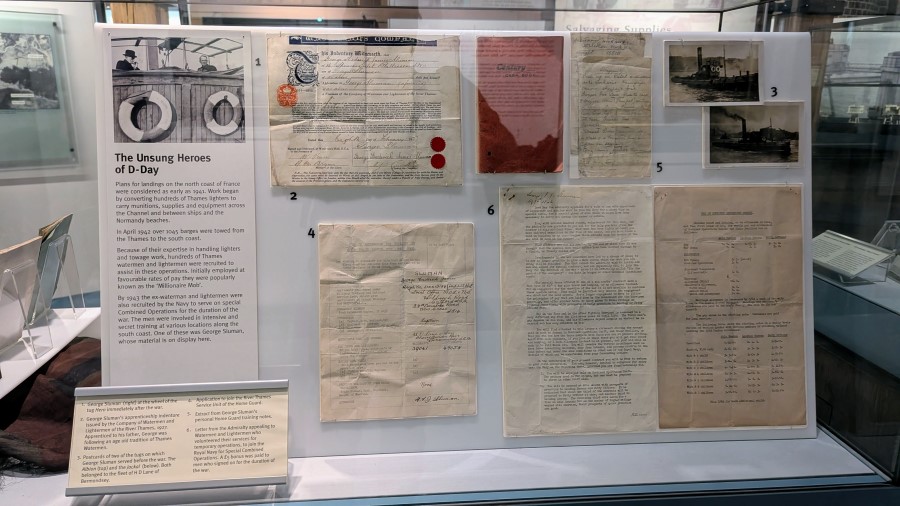
On 5/6 June 1944, Petty Officer Sluman found himself a coxswain on a landing barge carrying Canadian troops from Chichester to Juno Beach, where, under fire, he drove his barge through the lock gates at Courseulles-sur-Mer to deliver his troops.
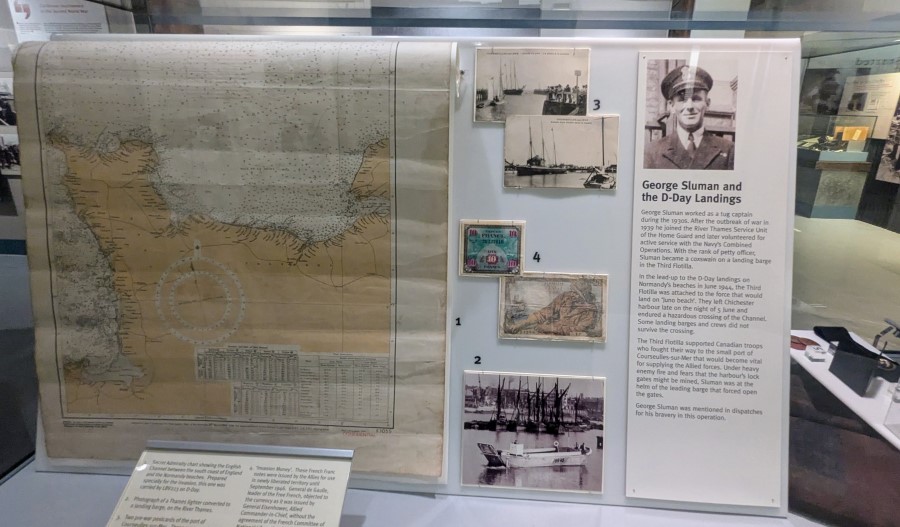
His info-boards are filled with photos, letters and certificates chronicling his career and achievements.
** A great thing about museums is their ability to suddenly illuminate something you hadn’t really thought about before. Despite a nautical background, I had no idea what a ‘lighter’ is/was. A type of commercial boat I assumed.
A lighter is a specialised type of flat-bottomed barge designed specifically to transfer cargo between ships and shore in harbours, effectively “lightening” a vessel’s load, whereas a barge is a broader term for flat-bottomed vessels designed for carrying freight over longer distances, such as on rivers or canals.
Ok, so what is/was the difference between a ‘Lighterman’ and a ‘Waterman’?
It comes down to what they transport. Watermen transport people and their luggage. Think of them as waterway taxi drivers. Lightermen transport goods and cargo.
Both professions are still overseen by The Company of Watermen and Lightermen of the River Thames, a historic City of London guild. The Watermen’s Company was founded in 1514, and the Lightermen joined them in 1700. In the past, both required a rigorous seven-year apprenticeship to become a Freeman of the Company and gain a licence to work on the river. Now they can do it in five years.
‘New Port, New City (1945 onwards)‘
This gallery covers, mostly through info-boards, the changes to Docklands and the Port of London since WW2, in particular the decline of the traditional docks due to containerisation and the transformation of the area into a financial district.
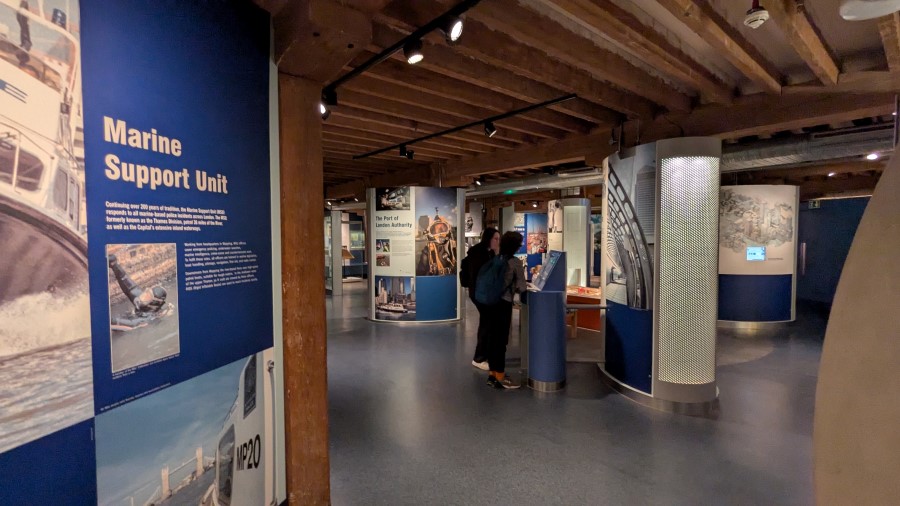
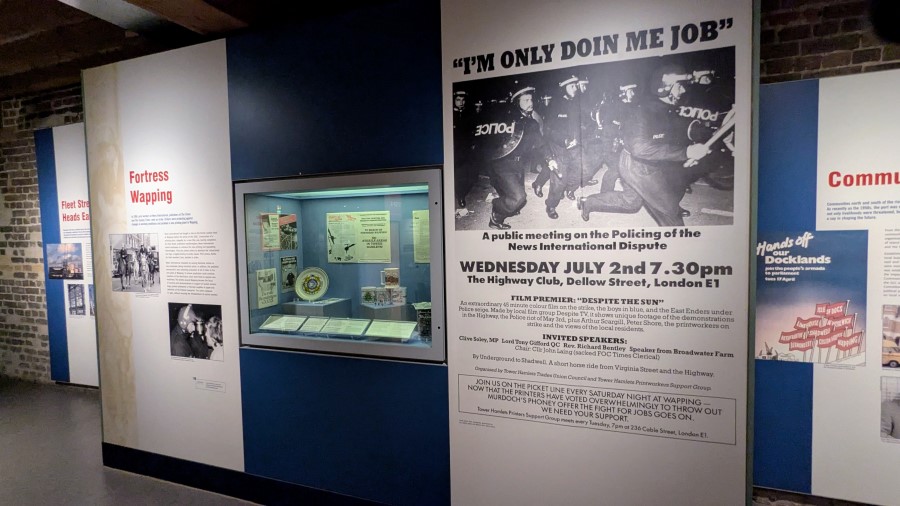
That includes major transformations like the construction of Canary Wharf, The Thames Barrier, London City Airport and the Docklands Light Railway, and events along the way – like the partial collapse of the Ronan Point tower block overlooking Victoria Dock in May 1968, Fleet Street’s newspapers moving to docklands and the protests in 1986 at News International’s “Fortress Wapping”.
London Museum, Docklands – First Floor
The first floor exhibition space melds the ‘Thames Gallery (1930 – 1940)‘ with the ‘Sainsbury Study Centre‘.
I thought at first, that the Sainsbury archive and the displays of its marketing & packaging artefacts were located here because of some early connection between supermarket and the docks. However, although there are some details of how trade was conducted via London’s docks, it turns out that the archive is actually one of three archives** that the London Museum holds, and it just happens to be located in the Docklands branch.
In the open area bordering the Sainsbury Study Centre, there are also some interesting documents from the PLA’s Port and River Library & Archives, including letters exchanged between the PLA and the British Antarctic Survey, some signed by Ernest Shackleton and later, Robert Scott.
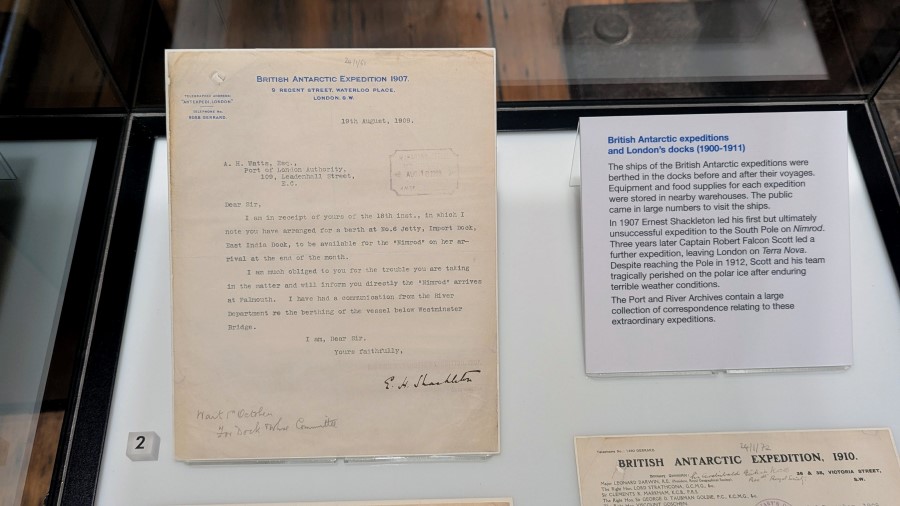
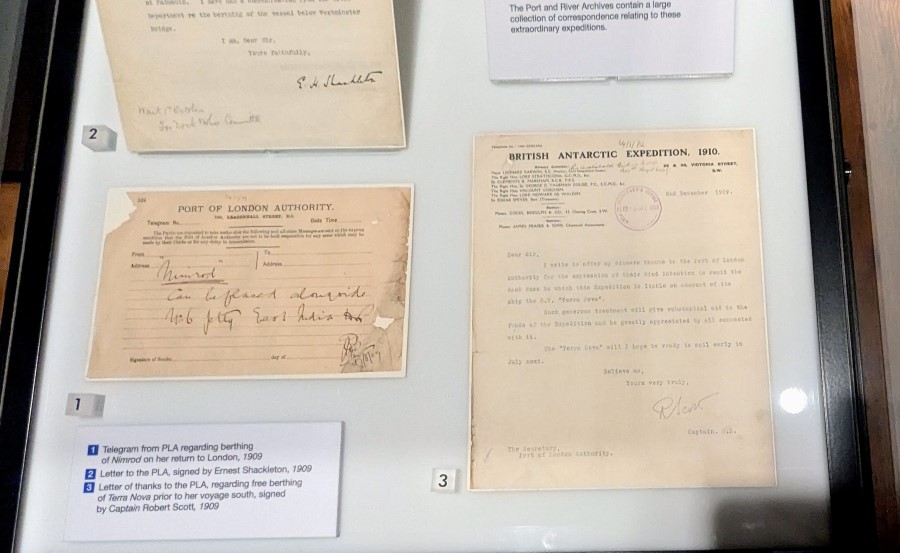
They remind me of the Scott expedition memorabilia in the dining room of the Royal Hotel in Cardiff, where Scott and his team had their farewell dinner on 13 June 1910, before departing on Terra Nova for their ill-fated expedition to the South Pole.
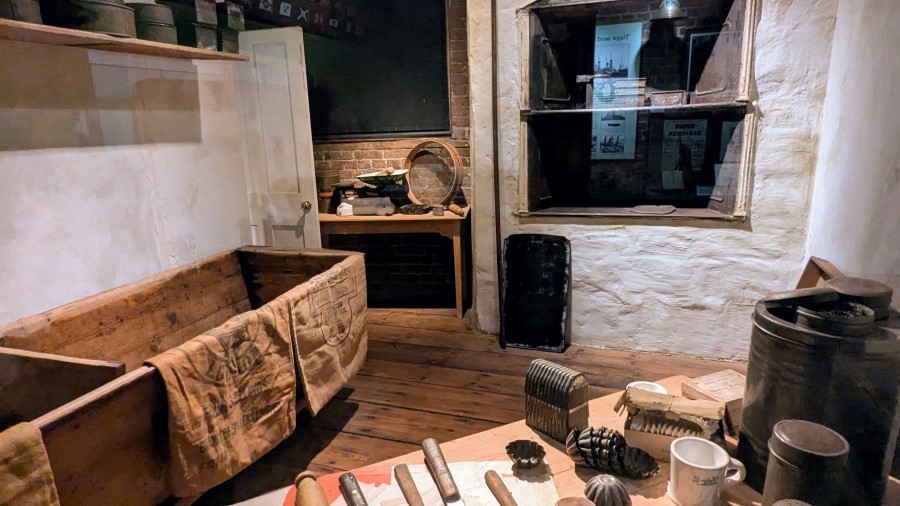
In the Thames Gallery there are more interesting exhibits from the 1930s. Here you’ll find a replica docklands bakery, together with a recreation of a ships chandlery.
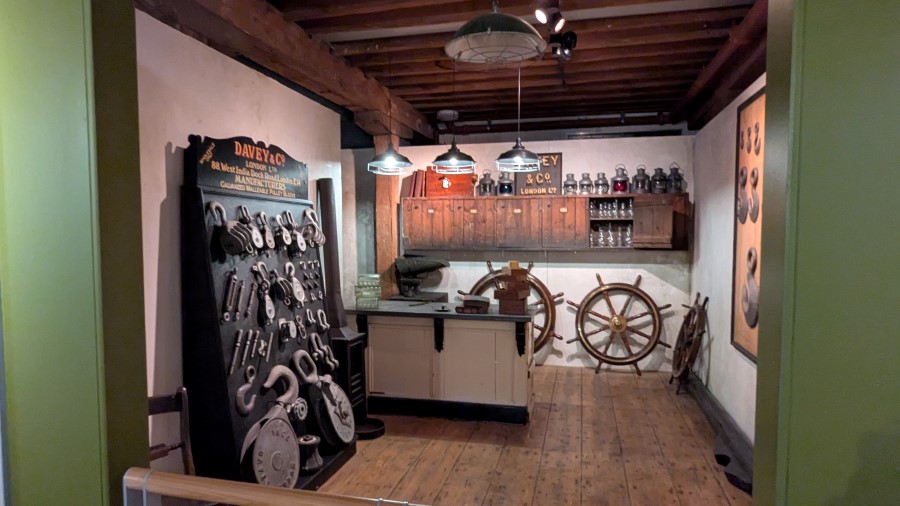
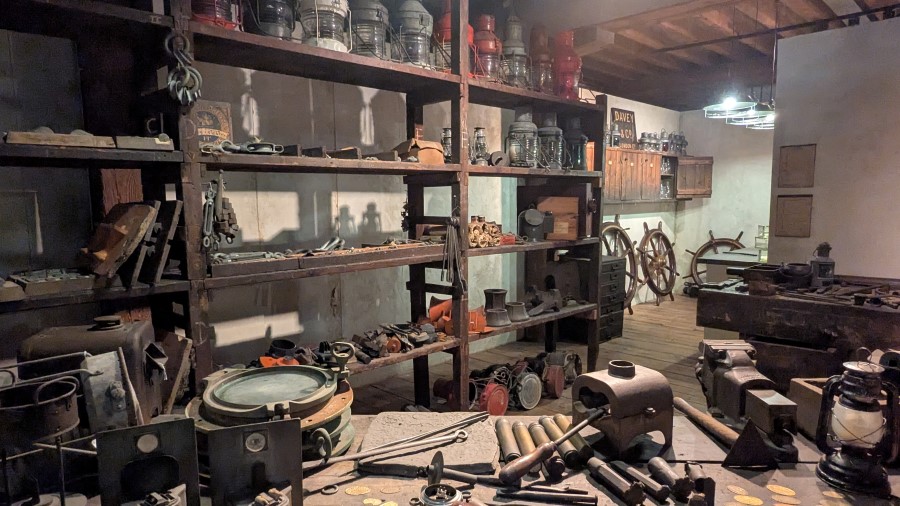
Ship chandlers like Davey & Co on West India Dock Rd supplied all manner of gear needed by ships and shipyards, such as ropes, tools, fittings, lamps, instruments and safety equipment. They also manufactured their own gear, like the blocks and tackle presented here. The Davey & Co brand was known worldwide and sold by mail order illustrated catalogues.
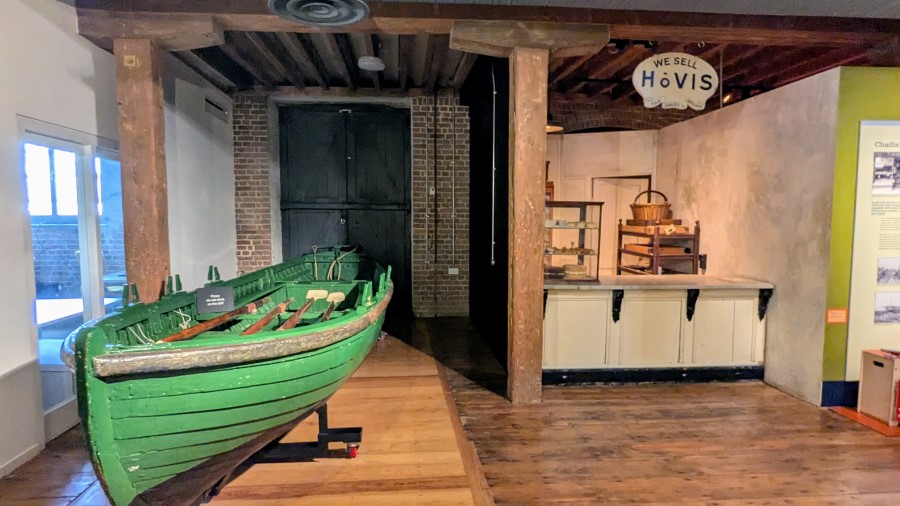
The green row-boat next to the bakery is a waterman’s skiff, built around 1920 for the Port of London Authority (PLA) by Cory’s Barge Works in Charlton. It was used as a taxi, ferrying passengers and their luggage across the River Thames, but also for jobs like delivering mail to ships anchored in the Pool of London, and handling ships’ mooring cables. It was found derelict in 1980 and restored.
One artefact that I liked on this floor, and wish I had taken a better photo of, is the board of shipping company house flags.
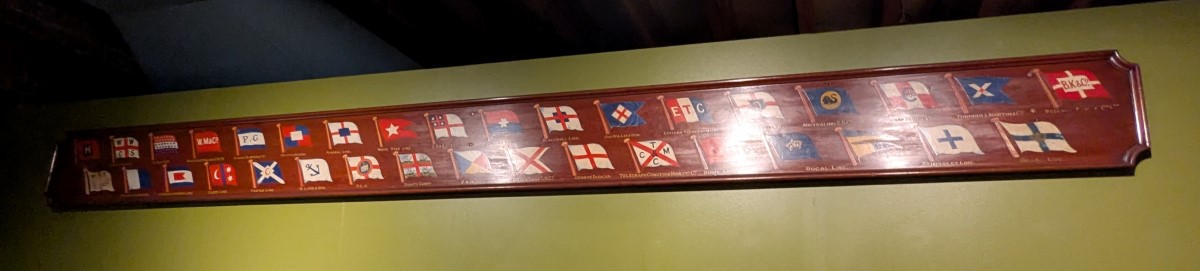
Shipping lines used distinctive house flags and funnel markings to identify their ships. This painted mahogany board was removed from the general office of Blackwall Yard, in 1987. It is likely that the board was created between 1890-1910 and records the owners of vessels repaired in the two dry docks on the site.
Declaration: I was on a press visit to an exhibition and stayed on to visit the free galleries.
* The Museum of London, now called more simply ‘London Museum’, has been located next the the old Roman Wall on the edge of the Barbican Centre since 1976. However in 2022 it was closed in preparation for a move to the old meat market at Smithfield, where it is due to reopen in late 2026.
** London Business Archive, the Port and River Archive, and Sainsbury Archive.
Factbox
Website:
London Museum Docklands
Getting there:
No. 1 Warehouse
West India Quay
London E14 4AL
The easiest way to get there is via Tube & DLR to Canary Wharf or West India Quay
Entry Price (2026):
Entry to the museum’s permanent galleries is free. Temporary/special exhibitions have a charge. See their website.
Opening Hours (2026):
The museum is open Monday to Sunday from 10am – 5pm all year round… except 24, 25 & 26 Dec