 By
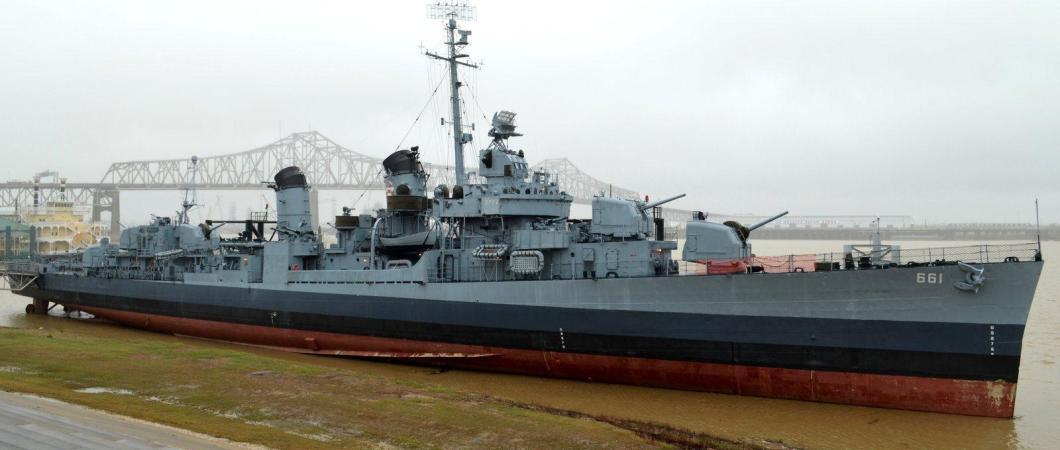
By Tom Hanks’ successful war movie Greyhound (2020), shot principally on the WW2 Fletcher-class destroyer USS Kidd, now a museum ship in Baton Rouge, Louisiana, is to have a sequel.
The movie industry news media are talking about ‘Greyhound 2’ although very little has been confirmed. We know that Hanks will once again play Commander Ernst (“Ernie”) Krause, and that Stephen Graham will return as Lieutenant Commander Charlie Cole, his Executive Officer and long time friend. However we don’t yet have any idea of the anticipated release date, and perhaps more importantly, the plot.
What is the original Greyhound movie about?
Hank’s wrote the Greyhound screenplay based on the 1955* novel The Good Shepherd  by C.S. Forester – probably best known for his Hornblower series and The African Queen.
It is set in the winter of 1942, the height of the war in the Atlantic, and features fictional characters on a fictional convoy. Its central character is a firmly religious U.S. Navy Commander, George Krause**, commanding the multi-national escort ships from his own destroyer USS Keeling (renamed ‘Greyhound’ for the movie). He doesn’t have that many escorts; just two destroyers: his USS Keeling and a Polish destroyer Viktor, plus two corvettes: HMS James (British) and HMCS Dodge (Canadian).
As the book starts, the convoy of 37 merchantmen is in the middle of the ‘Atlantic Gap’ where allied patrol aircraft can’t reach, and a wolf pack of U-boats is closing in on them. The book follows Commander Krause as he directs his forces over two days and nights with no sleep and little respite, as they rush around the convoy fending off attacks.
Indeed that’s one of the key aspects of the book. The pace is relentless making it almost impossible to put down. When I started reading it, I thought I’d put it down when I got to the end of the first chapter. Big mistake. There are no chapters!
This is one of the main reasons the movie has been so successful. Hanks’ screenplay stuck tightly to Forester’s text, which gave the movie its relentless pace and energy. Like the book, there are no pauses to take your breath.
Greyhound 2
So, what on earth will happen to Commander Krause in the new movie? Forester and Hanks both left him lying face down, exhausted, in his bunk having shepherded his flock through the Atlantic Gap. There is no guide this time. Hanks is off the map and starting with a blank sheet.
Will Krause & Cole be together again on Greyhound, or a different warship? Will they be once again hunting U-boats? I fear they may be tasked with capturing an Enigma code machine. If Hanks sticks to his usual historical accuracy, he might focus on the American capture of U-505 with its Enigma and codebooks on 4 June 1944.
The other major US Navy destroyer action that Hanks might choose is the escorting of the D-Day invasion fleet, and then close-up shelling of the German beach defences, but that was only two days later. Kreuse can’t be in two places at once, and Hanks might feel he has already done D-Day!
Maybe, Hanks will re-deploy them to the Pacific? Lots of Fletcher (Greyhound) and Gearing (Keeling)-class destroyer action there! I’ll post updates when I hear.
Back to the subject in hand…
Will they use USS Kidd again?
Well, it would certainly make sense. In Jan 2021, Tom Hanks wrote in the Los Angeles Times about the set they used for ‘dry land’ filming.
He confirmed that the USS Kidd is “as fine a motion picture set as it is a museum”, and they shot as much footage as possible on board including the firing of her guns. However the cramped interiors didn’t lend themselves to filming, so they built their own destroyer interiors (principally the bridge, its wings, foredeck and sonar room) on a sound stage nearby and mounted them on a huge gimbal to put it in motion so they looked (and felt) like they were at sea.
He said the movement was continuous and a bit like a roller-coaster ride, so the cast were “sometimes falling into each other, spilling our coffee, bumping our heads and chasing rolling pencils. There were many pencils used and much coffee spilled during the Battle of the Atlantic!”
Meanwhile, in TheWrap.com, Nathan McGuinness, the visual effects supervisor, talked about the extraordinary work of the CGI team, who created pretty much everything else in the movie in just 4 months!
That’s the ocean, the ships on it, the U-boats under it, and the sky, in 1,500 full CG shots built from scratch. Fortunately they’ve produced a video to demonstrate…
USS Kidd is currently away from her mooring in Baton Rouge, for an overhaul. It is hoped she’ll be back soon (“Spring 2026”). Meanwhile the museum building onshore is still open.
One interesting footnote to the ‘Good Shepherd’ story is that CS Forester also wrote a little-known U-Boat story. He wrote a play in 1931 based on a WW1 German mine-layer submarine, UB-116, sunk in the closing days of WW1 while trying to sneak into the Royal Navy’s anchorage at Scapa Flow, Scotland. The sub was on a near-suicide mission, hoping to cause maximum damage to the home fleet in a bid to secure better terms in the armistice.
His play, ‘U-97‘  was never produced in the UK or USA, but did run for nine performances in Germany, where it was performed as a propaganda piece about heroic German submariners in the build up to WW2.
* My 2nd edition, printed in 1957, is looking a little frayed, but much loved!
** For some reason, Hanks renamed him “Ernest” Krause.
*** In recent years ‘Greyhound’ has rarely dropped out of the Apple TV+ Top Ten movies, which no doubt explains why Apple want a sequel.
**** That would, in part, make up for the historical movie abomination that was ‘U-571’ (2000) derided by so many critics. The key U-Boat/Enigma capture events were:
- U-110 (May 1941): The British Royal Navy, led by HMS Bulldog, captured an intact Enigma machine and crucial codebooks. This was arguably the most vital capture of the war, as it allowed Bletchley Park to read U-boat signals for months.
- U-559 (October 1942): British sailors from HMS Petard recovered codebooks and an Enigma machine from the sinking sub. These documents were essential for breaking the new four-rotor “Shark” cipher.
- U-505 (June 1944): The US Navy captured the entire submarine, which contained two Enigma machines and extensive codebooks.
- U-570 (August 1941): This submarine surrendered to a British aircraft; while the crew attempted to destroy their machine, the Allies recovered enough material to be highly useful.
Feature image: USS Kidd in Baton Rouge, 2013 (CC BY-SA 3.0 By Niagara, own work, via Wikimedia Commons)
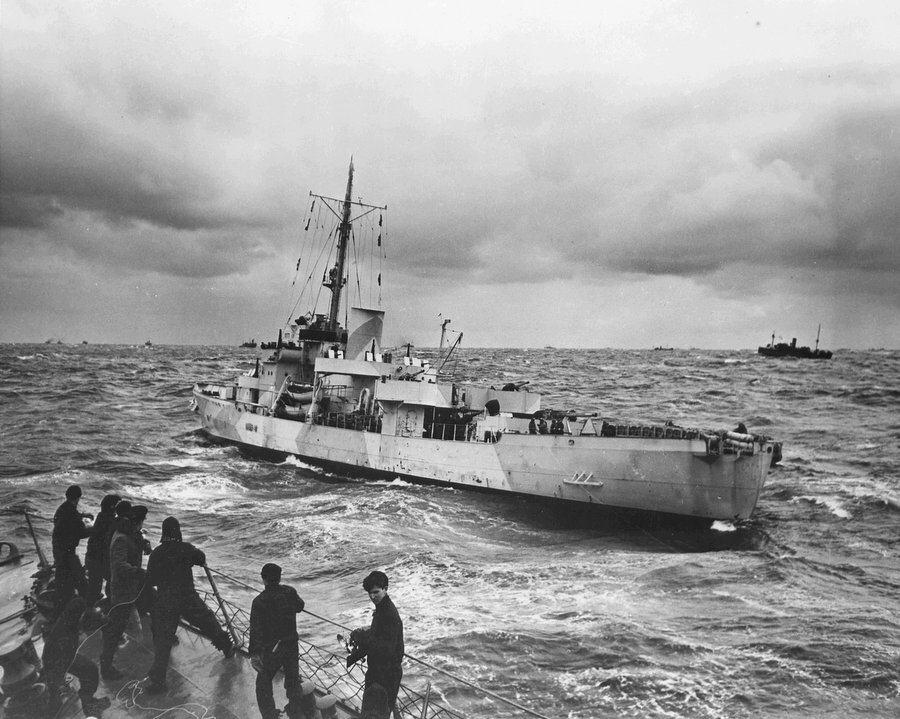
Convoy image: United States Coast Guard Cutter Spencer (WPG-36) during WWII in 1942 or 1943. Spencer sank the German submarine U-175 on April 17, 1943. Photographer unknown but possibly Bob Gates
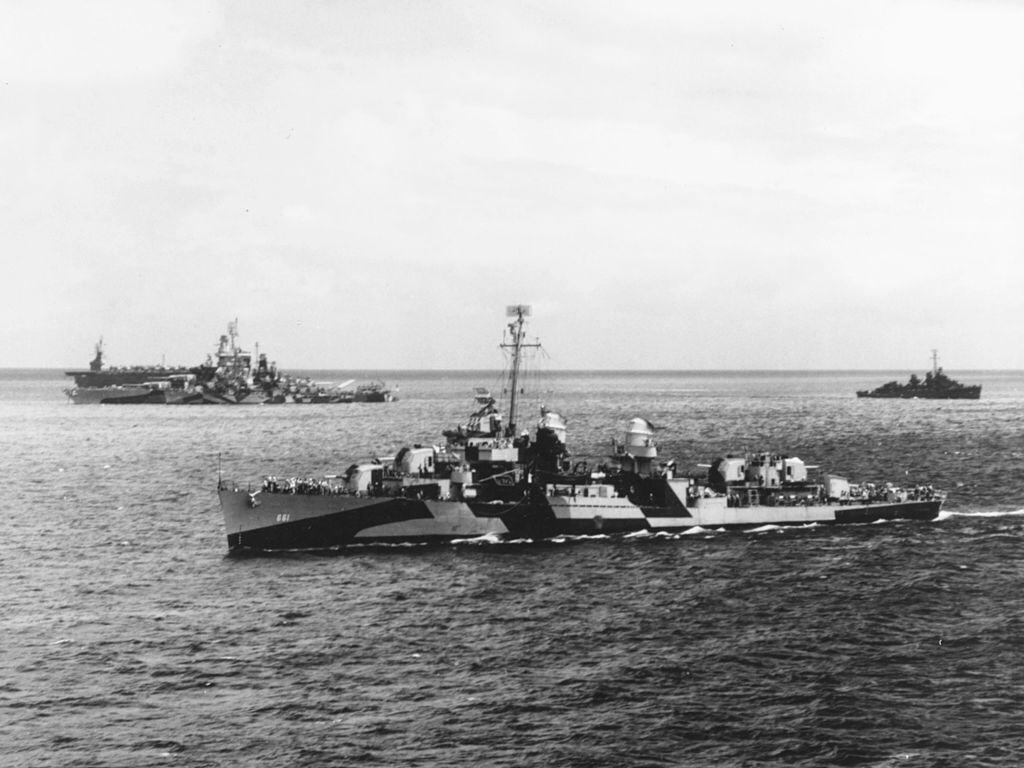
Pacific fleet image: USS Kidd (DD-661) off Roi Island, Kwajalein, en route to the Saipan Invasion, 12 June 1944. Anchored in the left background is the battleship USS Tennessee (BB-43), with a destroyer alongside and an escort carrier beyond. Photo taken from USS New Mexico (BB-40).