 By
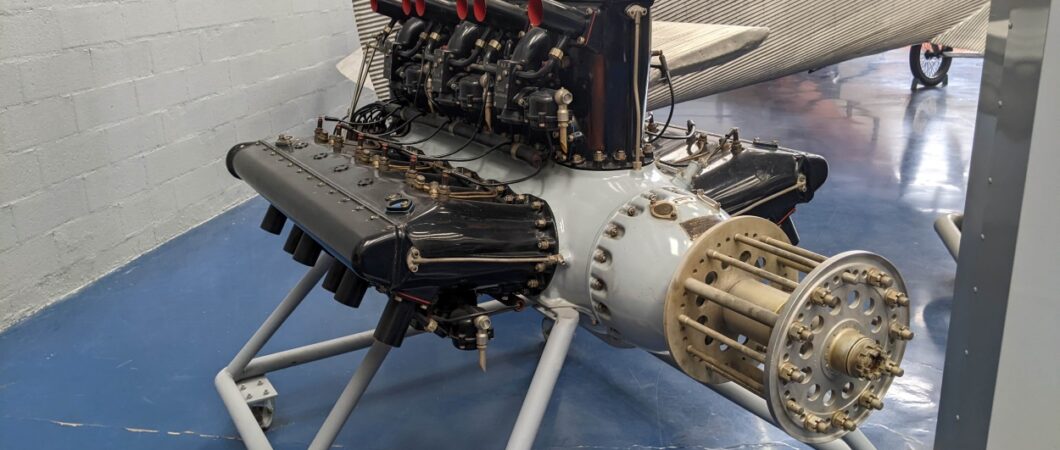
By The Hispano-Suiza 18.Sb is a rather quirky but powerful 18-cylinder aero-engine that kinda got lost in history!
It was designed originally as the Hispano-Suiza 18R to compete in the 1929 Schneider Trophy for seaplanes. It was ordered by the French Air Ministry who needed a 1200 horsepower engine to put in two competing aircraft; the Nieuport-Delage NiD-450 and the Bernard HV 120.
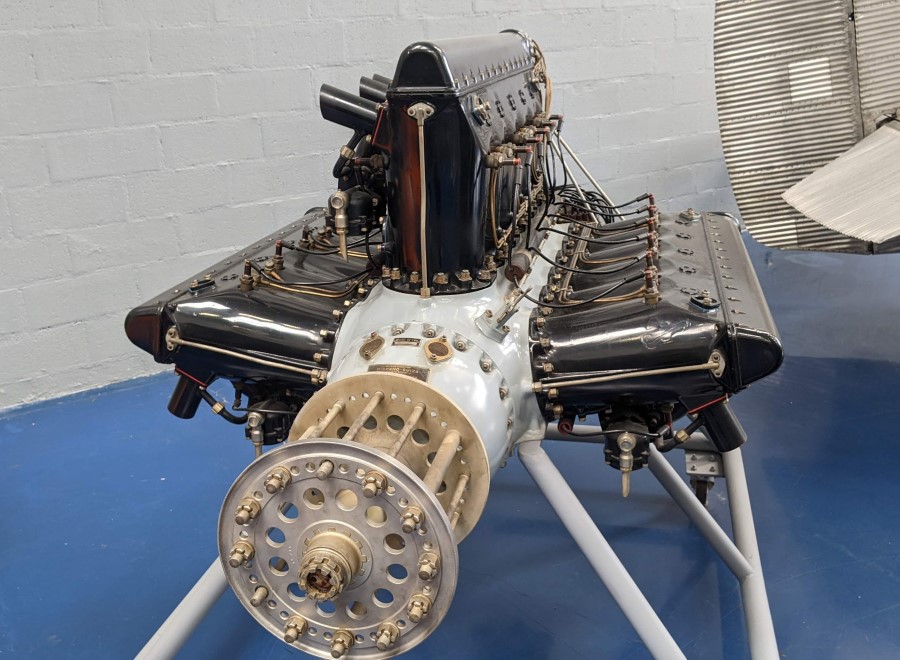
“But wait! You’re talking about the Hispano-Suiza 18R, but you’re showing me a Hispano-Suiza 18.Sb!”Hispano-Suiza based the 18R on a previous liquid-cooled 750 hp 12-cylinder engine of theirs. So the 18R had this odd layout with three banks of six cylinders in line, spaced apart at an angle of 80 degrees. They beefed it up by adding the extra six cylinders and significantly boosting the compression ratio, giving it a design power output of 1,600 hp – well above spec!
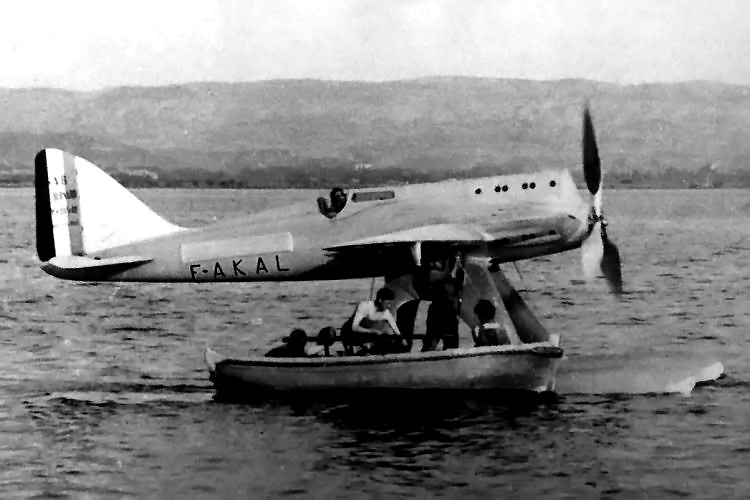
The problem was… that they had problems developing it, and failed to get it finished in time for the 1929 Schneider Trophy. Nor did it appear in either aircraft for the 1931 Schneider Trophy – it was fitted to the aircraft but a series of disappointing trials and crashes ruled the engine out of the running.
“But wait! You’re talking about the Hispano-Suiza 18R, but you’re showing me a Hispano-Suiza 18.Sb!”
Ah, yes. Well, after its failure at the Schneider Trophy, Hispano-Suiza decided they might as well get something out of the project and ‘un-beefed’ the 18R to make a 1,125 hp commercial engine, the 18.Sb, for use in a number of French and American aircraft.
The thing is, even at 1,125 hp at 2,000 rpm, this is still a powerful, if odd-looking, beast.
Early models of the fabulous Rolls Royce Merlin barely reached 1,000 hp. The Merlin XII (1940-41), used in Spitfire Mk IIs, was rated at 1,150 hp at 3,000 rpm, a whole decade after the Hispano-Suiza 18.Sb. AND the Merlin’s dry weight was 624-748 kg, where the 18.SB weighed only 540 kg.
Sadly though, while the RR Merlin was embarked on a steady trail of improvements* the Hispano-Suiza 18.Sb led a short and sporadic life in the skies. In the end it was only fitted to a handful of aircraft, many of them prototypes that were never put into production.
This Hispano-Suiza 18.Sb, which I believe is one of only two in existence, can be seen at the Air & Space Museum – Le Bourget, Paris.
* By mid-WW2 the Merlin XX/XXI, used in Hurricanes & Lancasters, began slowly increasing output to between 1,240 hp–1,300+ hp. Through higher boost pressures and improved two-stage supercharging, plus better fuel (100-octane), in its final variants at the end of the war, the Merlin was producing over 2,000 hp.