
 By
By Happy New Year everyone! What does the New Year hold for us, in the Mechtraveller worlds of engineering and technology?
Well, off the top of my head, there are a few anticipated/scheduled events and a couple of predictions…
Autonomous cars in London – We know Waymo has been human-driving their cars in recent months, gathering data for their cars to start testing them in autonomous mode. The plan is to begin autonomous taxi services later in 2026.
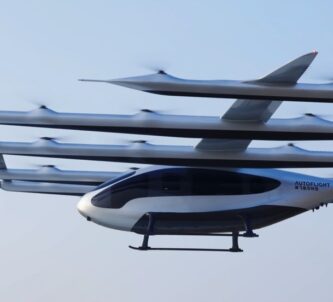
eVTOLs over London… or Bicester… or both – This is something that has been getting ever closer in recent months. I wrote about it last spring. Lots of eVTOL developers are already airborne, and I’m expecting a number of them may get licensed for passenger operations in 2026/7, possibly here in the UK.
100th Anniversary of TV – There might be some celebratory recognition for John Logie Baird’s invention. He first demonstrated his mechanical television system to members of the Royal Institution and a reporter from The Times on 26 Jan 1926.
The Dogger Bank Wind Farm: Reaching Full Operational Power – The Dogger Bank Wind Farm, located off the North East coast of England, will achieve full power in March 2026. This project is the world’s largest offshore wind development, with a total capacity of 3.6 GW, generated by GE Haliade-X 14.7 MW turbines, among the most powerful in existence, where a single rotation can produce enough electricity to power a typical UK home for two days.
Danjiang Bridge Completion – The Danjiang Bridge in Taipei, Taiwan, will be the world’s longest single-pylon, asymmetric cable-stayed bridge when it is completed in May 2026. Designed by Zara Hadid Architects and under construction since 2019, the bridge features a central span of 450 metres held by asymmetrical cables radiating from a single 200-meter-high concrete pylon.
Quantum Inertial Navigation Systems – This is something most of us will never see, but which will make a big difference to our safety. We all rely on Global Satellite Navigation Systems, but they are not always reliable; coverage can be patchy, technical issues can cause outages, and bad actors can interfere with the signals or spoof them (the Russians apparently like to interfere with GSNS signals around their borders). That’s why many aircraft and ships (civilian & military) use Inertial Navigation Systems (INS) based on gyroscopes as a back-up. These are very sophisticated these days but they can accumulate tiny errors that over time can render them un-reliable. Step-forward the Quantum Inertial Navigation Systems, that use the behaviour of super-cold atoms as near-perfect sensors. There are teams of scientists developing these and in 2026 we’ll see them being deployed more widely on the sea and in the air.
The Brenner Base Tunnel breakthrough – When complete, the Brenner Base Tunnel will be the world’s longest railway tunnel at 64 kilometres, connecting Fortezza (Italy) and Innsbruck (Austria). In September the exploratory tunnel achieved ‘breakthrough’. Now we are expecting the final breakthrough of the two main rail tubes in mid-2026.
and finally, on a more spiritual note…
Sagrada Familia completion – Started in 1882, the Sagrada Familia cathedral project in Barcelona was directed by Antoni Gaudí until 1926. The 2026 completion date for the construction will honour his centenary, with the addition of the Jesus Christ spire, which will make it the tallest church building in the world. Over the years, the incomplete construction has survived the Spanish Civil War and financial crises to become a major global tourist attraction. The design is based on reconstructed plans after the original models were lost, and the construction demonstrates how 21st-century architectural technology such as 3D modelling and stone-cutting robots can fulfil a 19th-century vision. There will still be a few years of interior decoration work.