 By
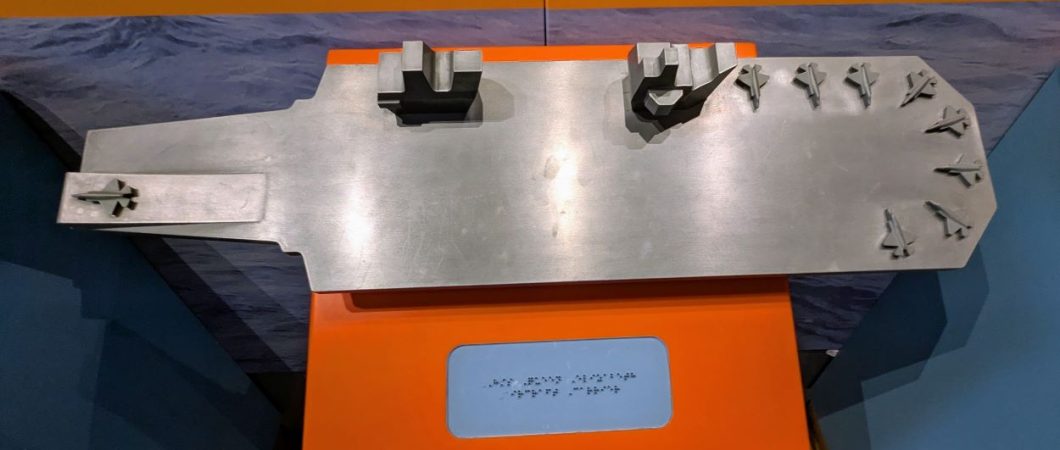
It’s a good question. And one that should be directed at a blind person. The concept is easy enough; it’s a ship with a flat deck that aircraft can land on, or take-off from, but what might it look like in a blind person’s imagination?
A few weeks ago I was paying a revisit to the Royal Navy Museum at Portsmouth Historic Dockyard, and suddenly came across this – a collection of three ‘tactile objects’ or ‘touch objects’. Three Royal Navy vessels: HMS Queen Elizabeth (Aircraft carrier), HMS Astute (Submarine), HMS Glasgow (Frigate). Each with their name in braille.
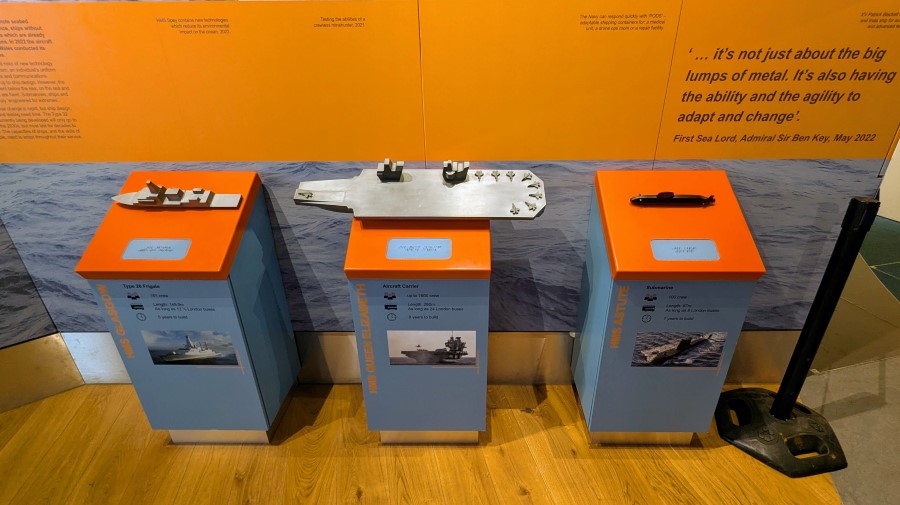
“Oh, now that is a good idea,” I thought, commending the museum in my mind for being so far-sighted (sic)!
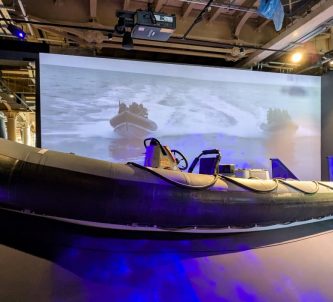
But then it occurred to me that I had just seen/felt something similar in the newly-opened Royal Marines Experience, also at the Portsmouth Historic Dockyard. Next to an encased historic Royal Marine headdress and crest, was one you could touch and feel.
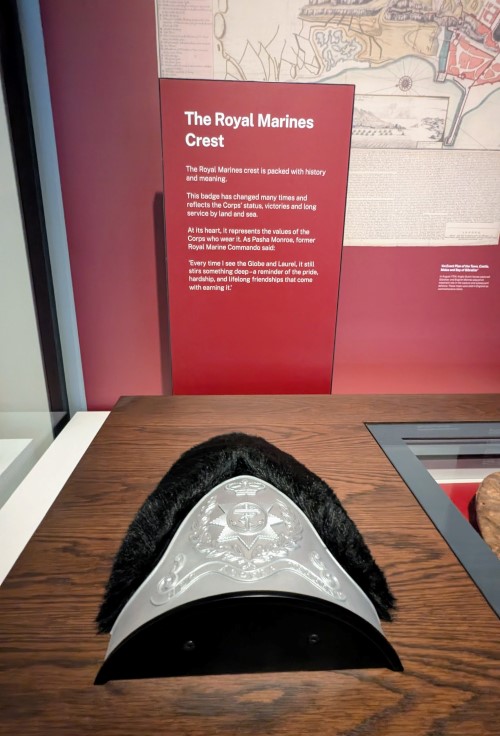
And this sent me down an accessibility ‘rabbit hole’, because I remembered seeing other similar objects in museums. The Imperial War Museum in London, for example, has a handful (7) of tactile objects in their galleries. I think these may be some of them.
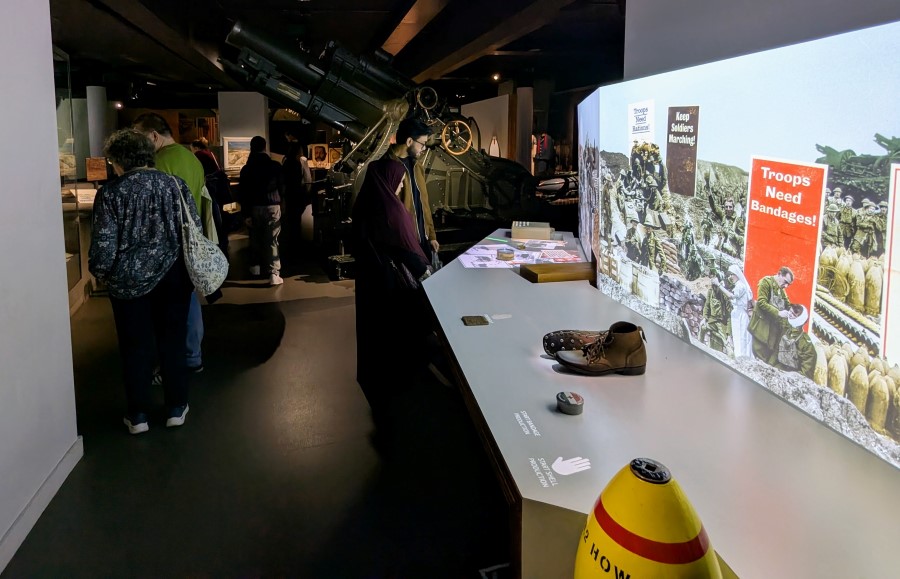
but art museums are way ahead of the game.These are unsupervised “tactile objects” & material samples placed in galleries for hands-on exploration. They can be original artifacts, replicas, or raw material samples (such as wood, metal, or fabric), and it’s great to see them appearing in military and technical museums, but art museums are way ahead of the game.
Museums like the V&A in London have had dedicated tactile objects for over a decade, such as 18th-century carved wood bosses and metalwork elements in spaces like the Europe Galleries.
And art museums also make use of specially created texture paintings to enable visitors to visualise and understand how the artist worked.
More and more museums around the world are making their collections more accessible to blind, partially sighted and neuro divergent visitors through tactile objects and even dedicated ‘touch tours’. There’s a list of some of them here.
So, back to military museums. What tactile objects would you like to see? I was thinking about this and thought that a robust, not too finely detailed, 3D printed model of Omaha Beach in one of the local museums, with landing craft, soldiers, and tanks (not many!) on the beach and bunkers & gun emplacements on the cliffs, would go a long way to illustrating the formidable mission faced by US troops, in a way an audio description might not.