 By
By It’s hard to imagine the U-boat war being conducted from a group of bunkers in the wooded grounds of a château just outside Angers, miles from the coast and the U-boat bases. But that’s exactly the point.
The British raid on Saint-Nazaire in March 1942 (Operation Chariot) really un-nerved both Kriegsmarine commander Grand Admiral Raider, and head of the U-boat service, Admiral Doenitz. They decided to re-locate their U-boat HQ and communications hub from Lorient where it might now be vulnerable to a similar raid, to somewhere safer inland.
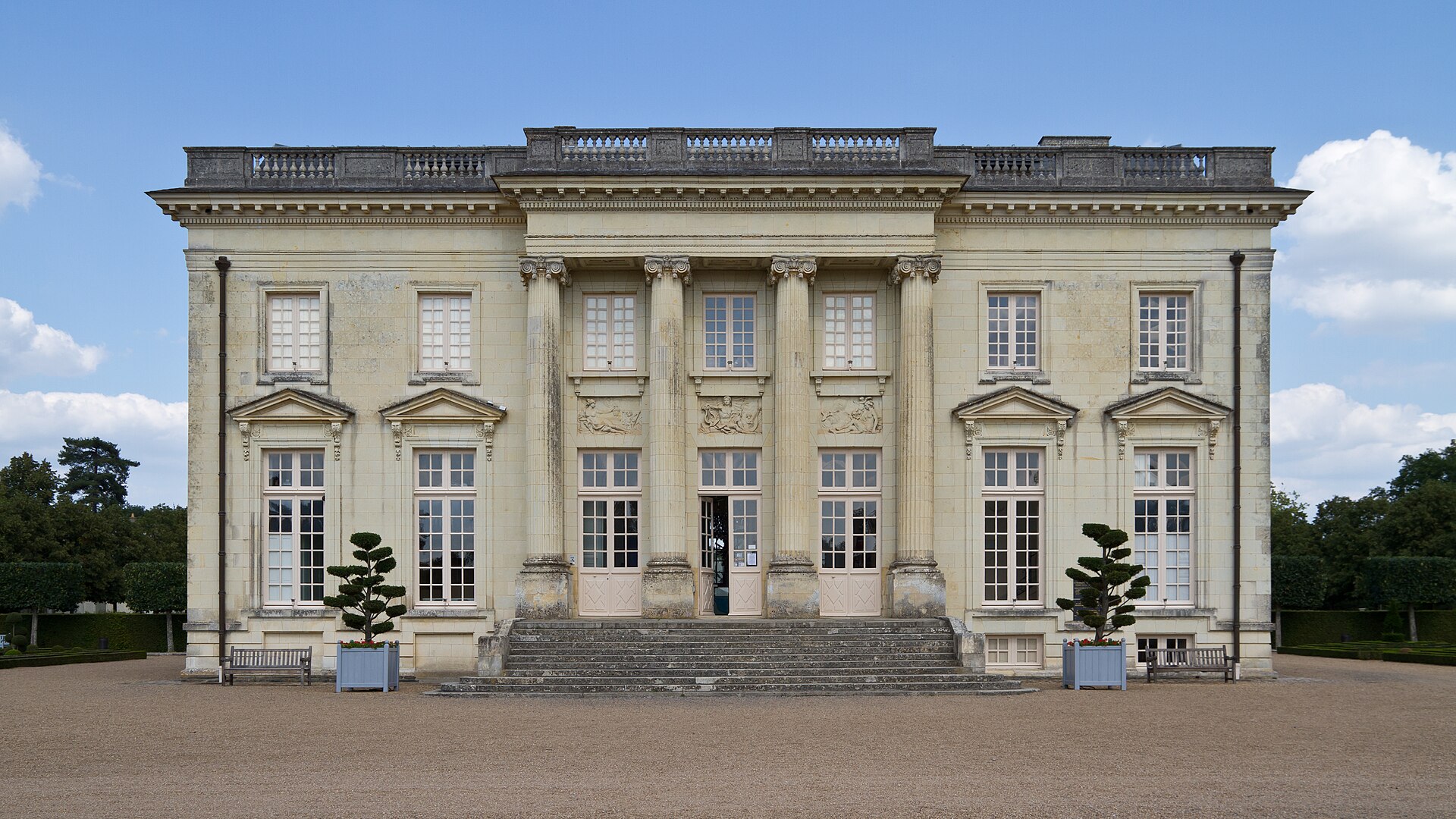
The Château de Pignerolle on the outskirts of Angers seemed a good site: 80 miles (130 kms) inland from Saint-Nazaire, woods in which to hide, with surrounding flat terrain that would suit radio transmissions. Plus there was an elegant château in which to accommodate and entertain the highest ranking officers*. This would be the new high-security HQ for the Führer der Unterseeboote West (FdU West).
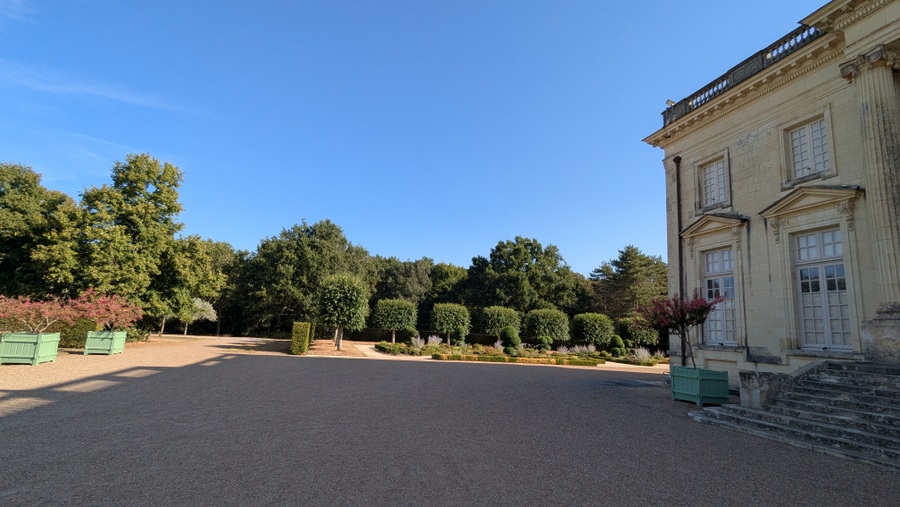
the work was completed by thousands of willing FrenchmenWork began immediately on building the bunkers that would house the 1,000 troops & staff needed to run the communications centre, and provide support services and security. By April 1943 the site was operational.
And the work was completed by thousands of willing Frenchmen, explained our guide, Alain Benoist from the Association du Mémorial des Bunkers de Pignerolle.
“Local workers volunteered for bunker construction along the Atlantic Wall and here at Pinerolle, to earn a good income when other industries were shut down, and to avoid being drafted into forced labour in Germany under the Service du Travail Obligatoire (STO).”
There are 10 bunkers located in the estate and an eleventh near the local suburb of Saint-Barthélemy. The main bunker was the command & communications centre, while the smaller surrounding bunkers were built for troop shelter during air raids, storage and defence (anti-tank and AA). The troops didn’t live in the bunkers. They lived in wooden barracks nearby.
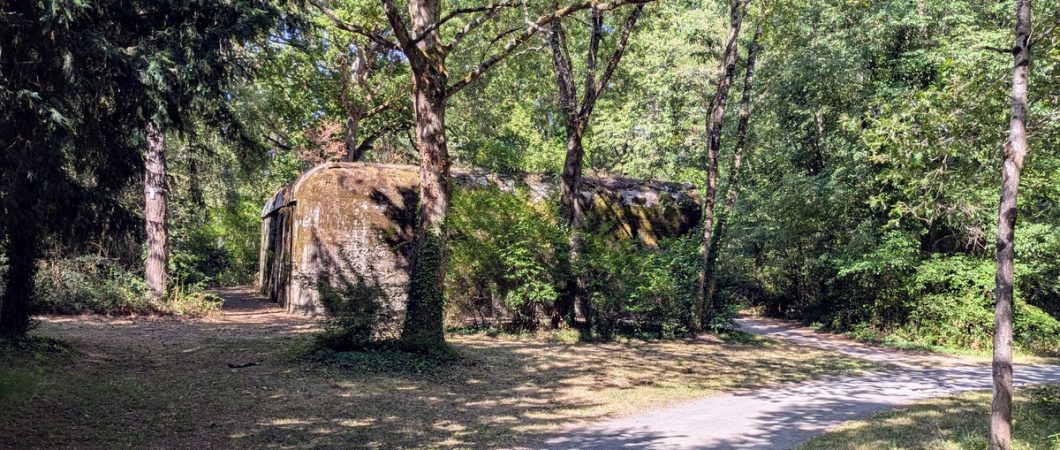
The 1,500-square-metre main bunker complex, known as the “Admiral’s bunker”, is the largest. It includes three multi-level structures with the exposed upper sections, built to follow the contour of the terrain. It is closest to the château, hidden just inside the tree line.
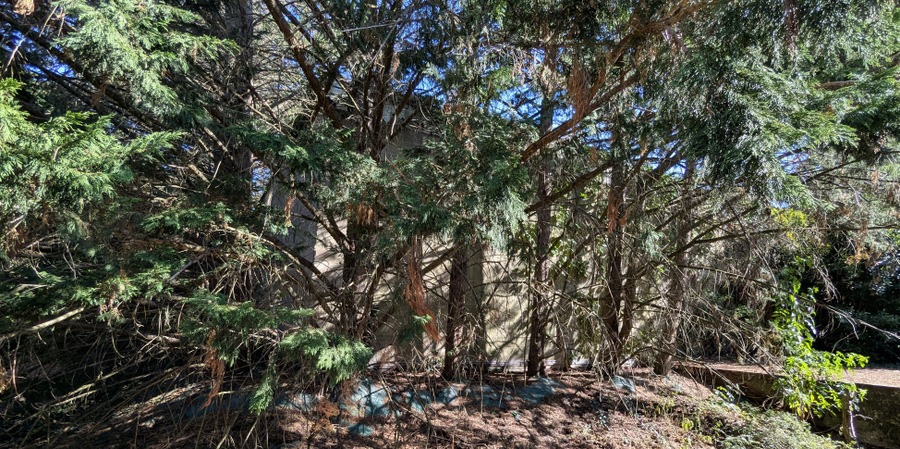
And even today it is almost impossible to spot from even a few metres away. It is connected to the cellars of the château by an underground tunnel.
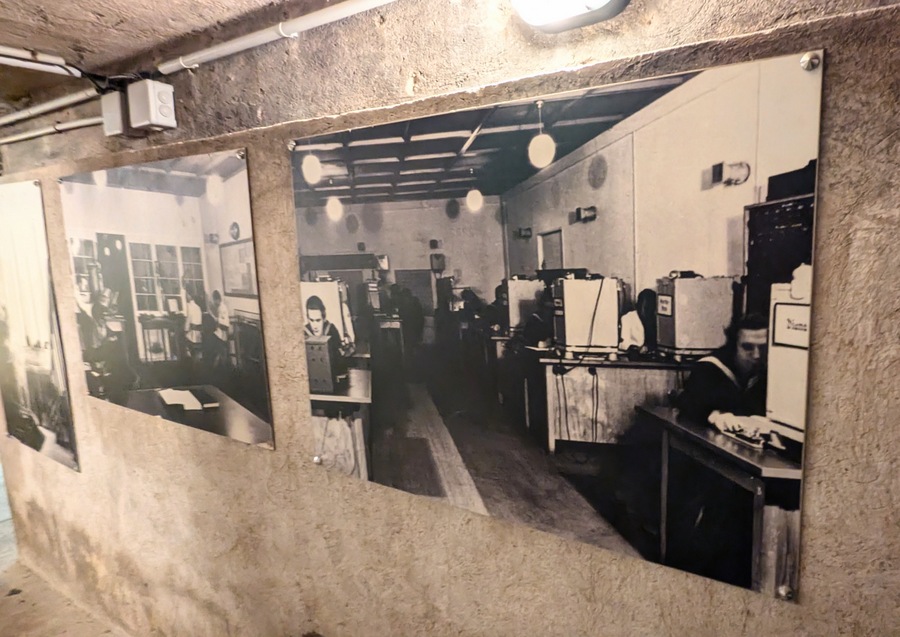
Its main function was to handle communications with the u-boat fleet, receiving and sending Enigma-coded messages to u-boats at sea through its array of 16 HF aerials and powerful relay stations like Basse-Lande near Nantes.**
Tactical orders for the fleet came via secure telephone and teleprinter lines from the Befehlshaber der Unterseeboote (BdU), which operated from the Tiergarten in Berlin until January 1943 when Allied bombing forced it to move to the “Koralle bunker” in the forests northeast of Berlin.
Pignerolle’s secondary function was to manage the logistics behind those orders; shipyard matters, port control, supplies, crews and maintenance.
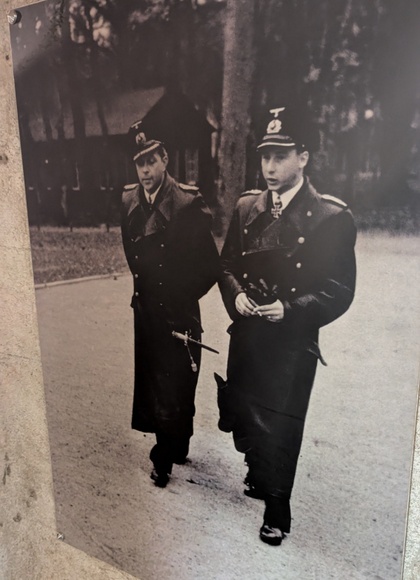
wearing the Knight’s Cross around
his neck) walking at Pignerolle
with another officer
The radio operators, coders and de-coders, and those working in the Situation Room, worked a 24/7 routine in three watches (shifts) under Kapitän zur See Hans-Rudolf Rösing. As the FdU West, Rösing was the primary commander stationed at Pignerolle from April 1943 until the German retreat in August 1944. He was responsible for managing eight U-boat flotillas based at Brest, Lorient, Saint-Nazaire, La Pallice, and Bordeaux.
His boss, Admiral Dönitz, controlled operations mostly from Berlin or the “Koralle” bunker, but he was a frequent visitor to Pignerolle, staying there approximately 15 times in 1943. He maintained private apartments on the first floor of the château and had a dedicated room within the main command bunker, which he could easily reach via the tunnel.
On 4 August 1944 the Germans abandoned their base at Pignerolle, setting fire to sensitive equipment and papers before the Allies arrived.
So, what is there to see at Pignerolles today?
Well, there’s good news and bad.
After the war, the bunkers were taken over by the French military, and as the Cold War emerged, the main bunker was turned into a top secret nuclear fallout centre for President Charles de Gaulle. Unfortunately, in the wisdom of the time, the walls of the main bunker were covered with asbestos as a fire precaution. This means the general public cannot get to see it because of the hazard to health.
In the 1970s the Pignerolle estate was handed over to the local authorities and a Museum of Communication was established in the château. Unfortunately it was closed in 2015 and the château itself has remained closed to the general public ever since.
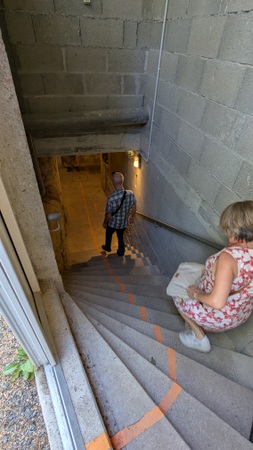
to the Admiral
bunker entrance
The good news is that a dedicated volunteer association, the Association du Mémorial des Bunkers de Pignerolle, was formed in 2010 to look after the site and raise awareness of the bunkers. It offers guided tours of some of the bunkers, primarily on Tuesdays and Sundays, by reservation only. The tours are technically free, but they do ask for donations to help with the upkeep of the site.
For special interest groups, they will sometimes open up the main bunker. Sadly on my visit the two keyholders – the president of the association and an estate gardener – were both on holiday! I’m told though, there’s not much to see in there; a few rusted metal cabinets and cold war junk. You can see for yourself on the association’s website where they have a digital virtual tour of the Admiral bunker.
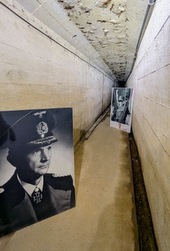
to the château
What you can see on a normal tour is the entrance to the Admiral bunker and a stretch of the underground passage from the château, with two large photos of the two main men who used it – Admiral Dönitz and Charles de Gaulle.
There’s also another low-ceilinged passage that leads to an armoured generator room. The idea was that attackers would have to approach the defended door, under fire and crouching.
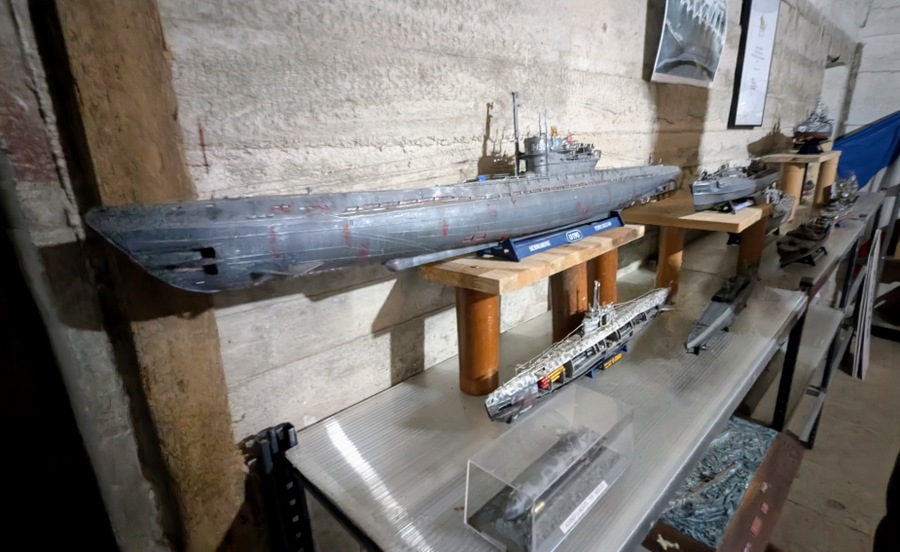
Nearby there are a number of smaller bunkers, including a bunker used as the Association’s base where they hold talks and presentations.
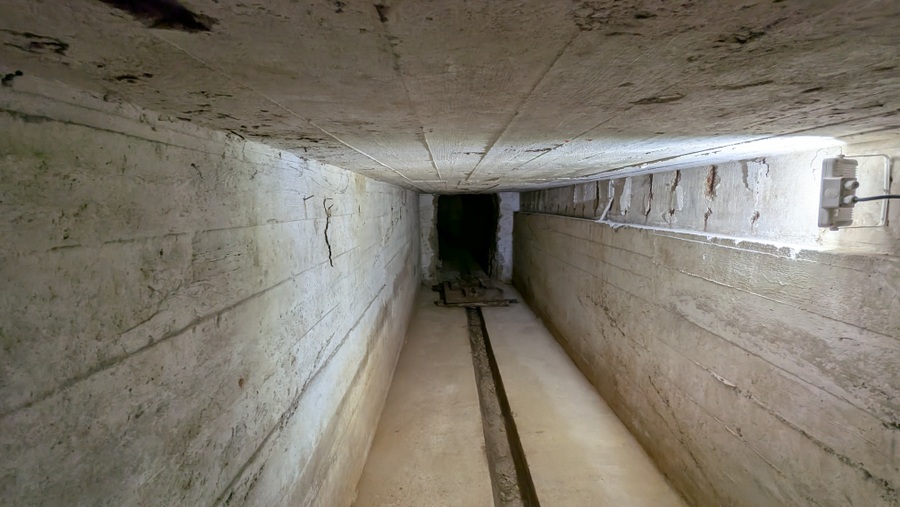
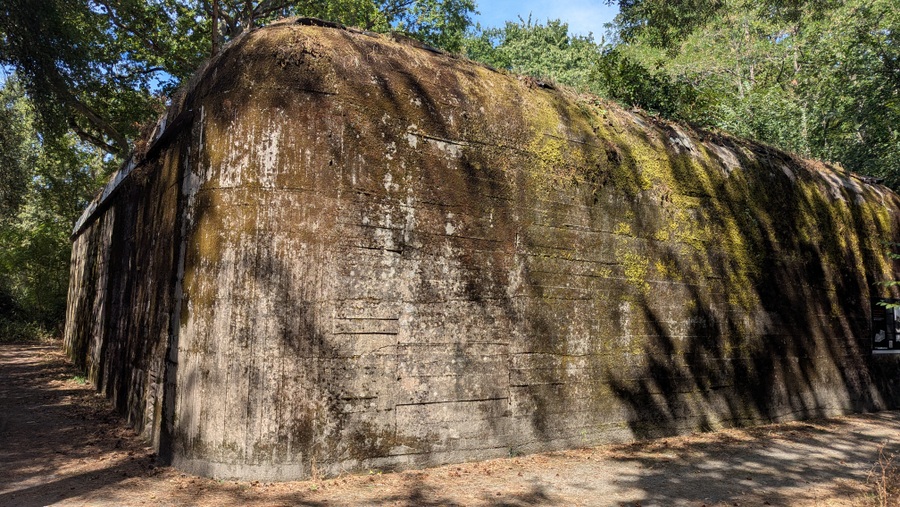
The 80-hectare estate is open to the public year round, so it’s easy to walk around and see the bunkers from the outside… and the swimming pool. The Germans built a swimming pool for the benefit of officers.
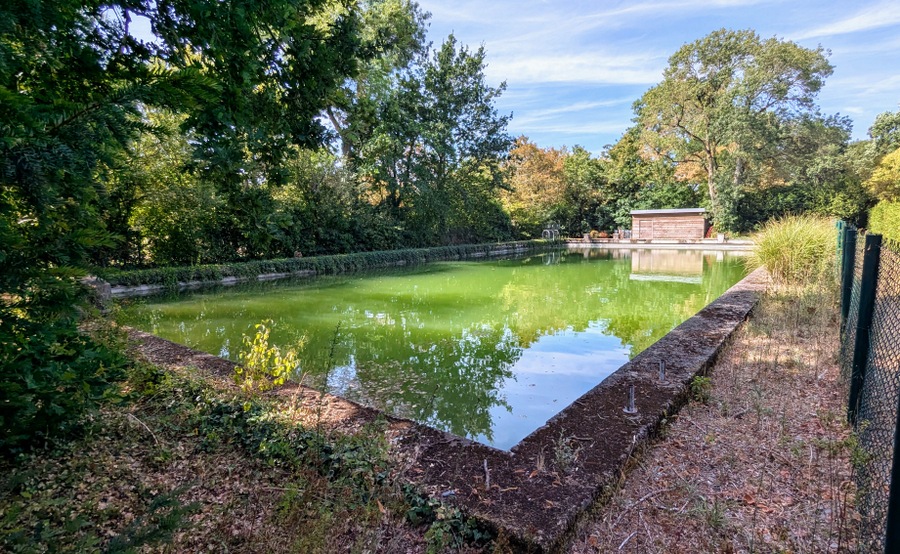
But it had a practical purpose too, as a water reservoir for fire suppression should they be bombed…
Was the site ever bombed?
No!
Pignerolle was the central German communications hub for the ‘Battle of the Atlantic’ and by September 1941 Alan Turing and his fellow code-breakers at Bletchley Park were busy intercepting and de-coding most of their Enigma-coded traffic. A bombing raid risked changing the Kriegsmarine operations, location and/or codes, so the Allies prefered to pretend they had no knowledge of Pignerolle or its significance.
* It had already entertained some VIP guests. Following the German invasion of Poland in Sept 1939, the Polish government in exile was based at the Château de Pignerolle for approximately six months until June 1940… when the Germans invaded France and they had to escape once again, this time to England.
** Operational U-boats thousands of miles away received these signals primarily as high-frequency surface broadcasts at night, or via powerful Very Low Frequency (VLF) transmissions that could penetrate shallow water up to 40-50ft, allowing u-boats to receive orders and intelligence without needing to surface. Mostly though, they would receive long-range HF Morse code traffic when they charged batteries on the surface at night and extended their long wire antennas.
Declaration: I was one a visit organised by Destination Angers.
Factbox
Guided Tours:
You can get in touch with the Association du Mémorial des Bunkers de Pignerolle to organise a guided tour by phone: 06 98 44 80 06 / 07 87 40 11 86, by email: association@memorial-bunkers-pignerolle.org or through their website: memorial-bunkers-pignerolle.org.
Getting there: Domaine de Pignerolle, 49124 Saint-Barthélemy-d’Anjou
I would suggest the car park at W3W ///jogging.perfume.routine is the best to aim for.