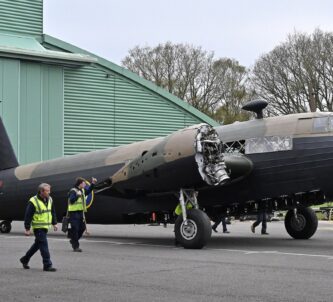
 By
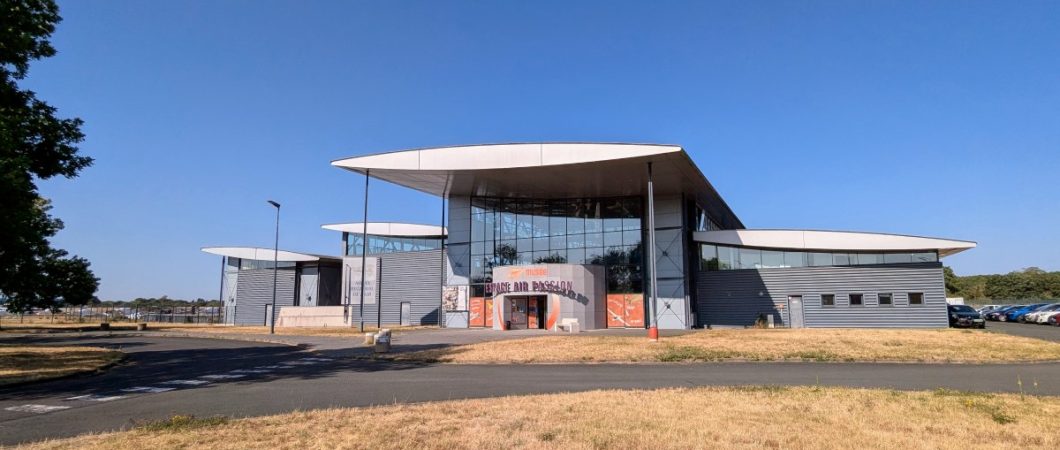
By The Musée Espace Air Passion at Angers airport is focused on the restoration and presentation of extraordinary French aircraft, or aircraft with a French connection.
The majority of the collection is made up of rare, often unique, civil light aircraft and historic gliders, some of which have been restored to an airworthy condition.
Importantly, the museum provides a way for the Groupement pour la Préservation du Patrimoine Aéronautique (GPPA)*, an association dedicated to preserving aeronautical heritage, to present its work. And since 2020 it has been officially certified as a ‘Living Aeronautical Heritage Workshop’. Visitors can see the workshops where volunteers and specialists work year-round restoring vintage aircraft and their woodwork, fabric coverings, engines, airframes, and instruments.
The museum’s purpose-built building is modern, light and spacious with lots of glass and walkways around the walls so you can get close to some of the suspended aircraft and look down on the collection. It may be spacious (3,500 m²) but into that space some 40 aircraft and hundreds of artefacts are crammed, so it doesn’t feel all that spacious!
So what is there to see?
Well, there are some pretty unusual, rare, and significant aircraft as I learned while being shown around by François Blondeau, the Président of the GPPA. I’ll mention a couple here but for a much more detailed list of what’s on display and the stories behind them…
The tour starts with the museum’s oldest aircraft, René Gasnier’s Gasnier III (1908), one of the oldest surviving aircraft in the world.
Similar to the Wright brothers Flyer (for good reason, as you’ll see) the Gasnier III is a biplane (the oldest surviving French biplane) with a canard control surface at the front and conventional tail surfaces. Unlike the Flyer which had a single engine powering two pusher propellers, the Gasnier III has a single Antoinette engine driving a single pusher propeller.
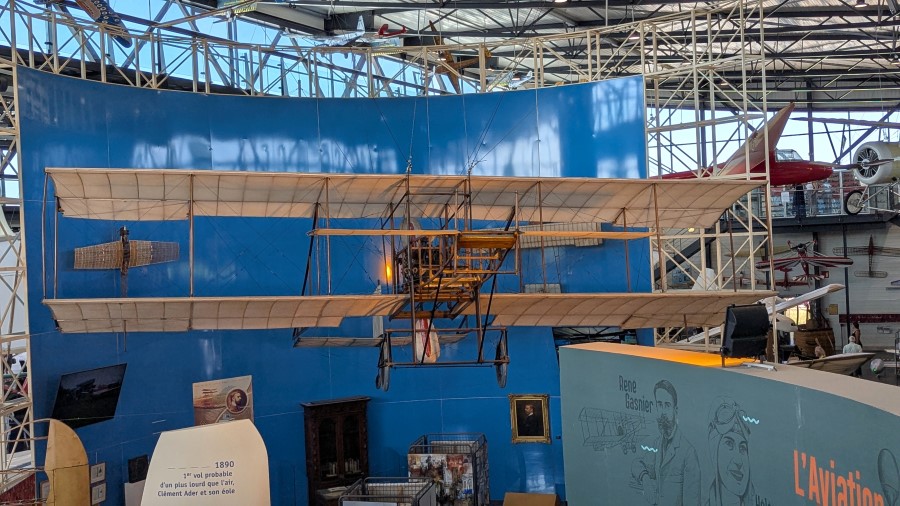
René Gasnier started his aviation career in balloons. He made several long-distance balloon flights across Europe and even crossed the English Channel.. at night! In 1907 he represented the Aéro-Club de France at the 1907 Gordon Bennett Cup held in the United States.
He returned to France in early 1908 inspired by the advances in science & engineering that he’d witnessed in the USA, and started working on a heavier-than-air flying machine. Then, astonishingly, a few months later, none other than Wilbur Wright himself turned up at the Hunaudières Race Course in nearby Le Mans to publicly debut the Wright Flyer. Gasnier and his brother Pierre were transfixed!
Straight away they started building a second prototype, the Gasnier II, which they successfully flew for approximately 500 metres at a height of about 5 to 6 metres, on 17 Sept 1908. Shortly after the Gasnier II crashed, slightly injuring René. This led to a number of flight control improvements and a larger 50hp Antoinette engine in his third prototype, the Gasnier III, which flew several test flights, some reportedly up to 1 kilometre. This is the aircraft, now restored, that lives in the museum.
Gasnier also created Angers’ very first airfield at Avrillé, a commune on the NW outskirts of Angers, where he founded the Aéroclub de l’Anjou. It became the Angers-Avrillé Airport and operated till 1998 when it was dismantled to make way for urban expansion, at which point all operations and the museum (later named Espace Air Passion) moved to the current Angers-Loire Airport in nearby Marcé NE of Angers.
So, like his pioneering aircraft, René Gasnier is very much at the heart of this museum.
There are many amazing and largely unknown historic aircraft on display at the museum, but here are a couple more examples…
For me, one of the most interesting… and bizarre… aircraft in the collection is the Alérion Riout 102 T.
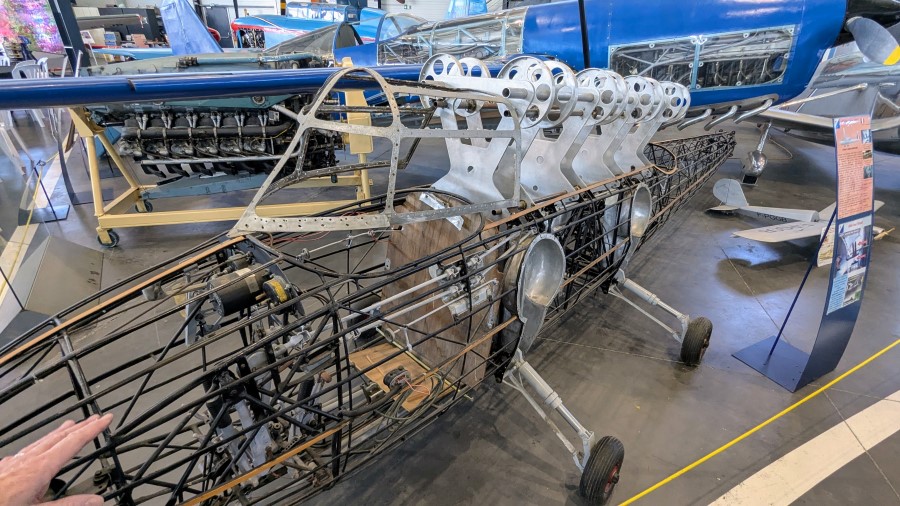
Now I thought the idea of flappy wings died out in the 19th century, but seemingly not! The Riout 102T Alérion was an ornithopter built in 1937 designed by René Riout.
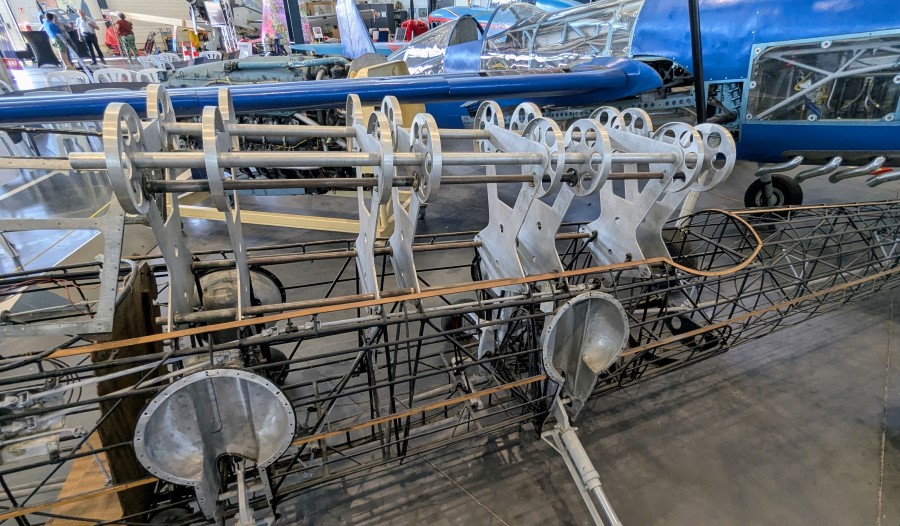
Not surprisingly it attempted some ground tests which included a wind tunnel test in 1938 when the wings suffered “a structural failure” (probably torn right off!). Then WW2 intervened and thankfully it was stored before killing anyone.
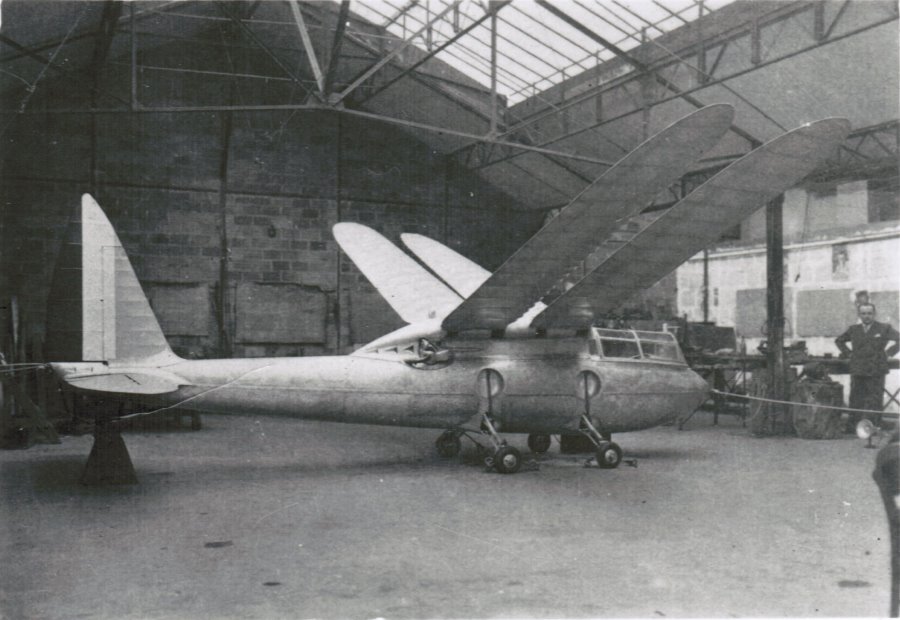
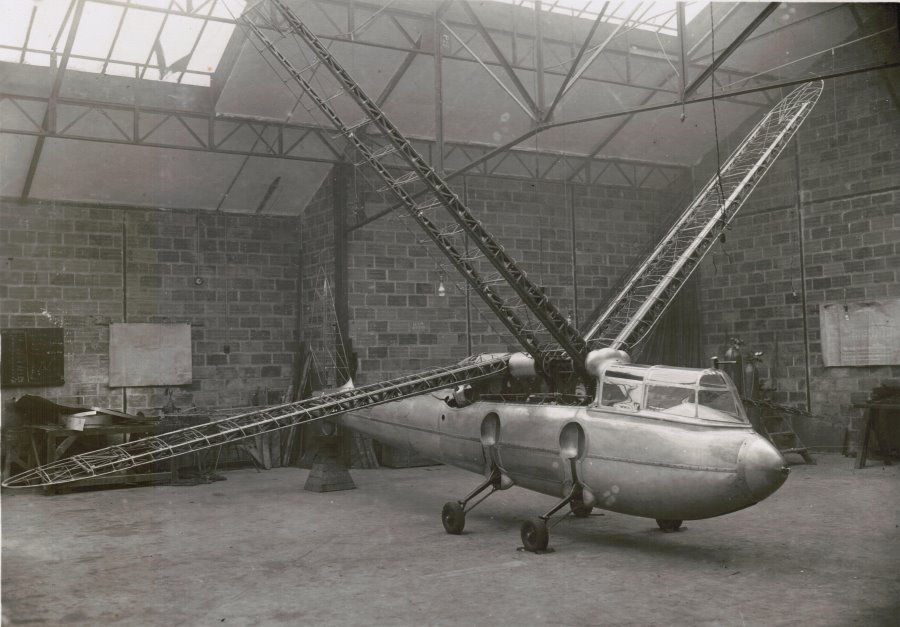
It was found again in 2005 and brought to the Musée Espace Air Passion where the fuselage with its wing gearing were partially restored.
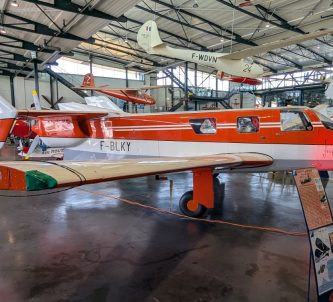
One of the museum’s prized possessions is the Moynet 360-6 Jupiter, a 6-seat business aircraft with two engines in a push-pull configuration.
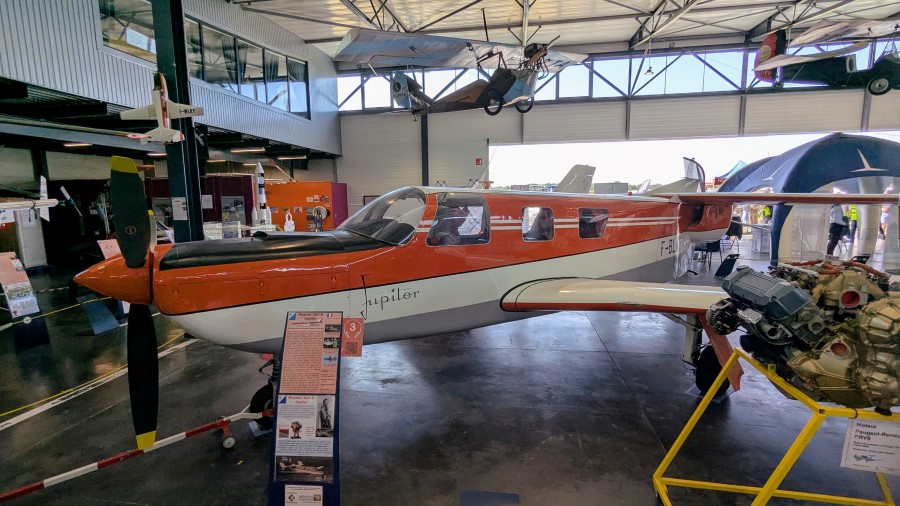
André Moynet was a hero of the famous French Normandie-Niemen squadron, which served on the Russian front (1942–45)**. After a post-war career as a test pilot, he had two wins at the Le Mans 24 hour races; one as a driver in 1953, and one as a designer in the 1975 edition. He also designed sports boats, so no surprise that he should turn his skills to aircraft design.
In 1961, he embarked on a project to build a 6-seat business aircraft that would offer the safety of a twin-engine plane while handling like a single-engine model. It featured a distinctive “push-pull” engine configuration, with one engine pulling and the other pushing.
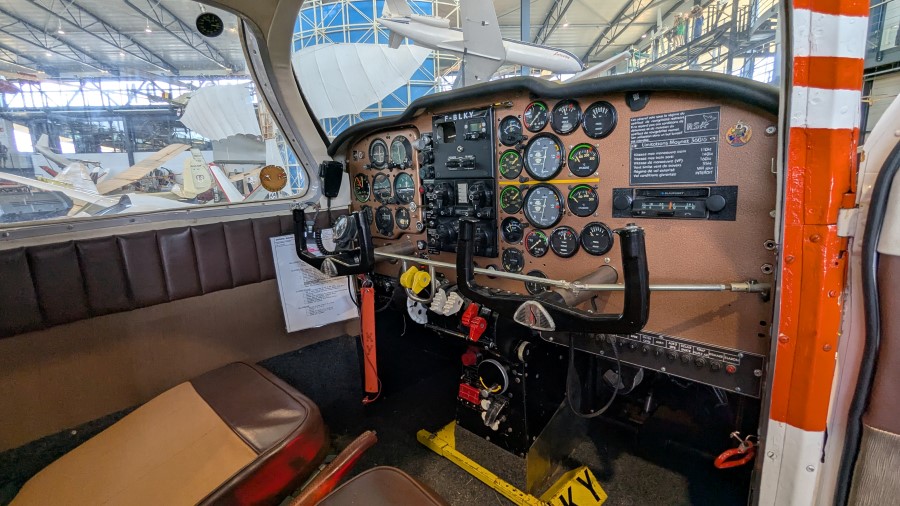
The Moynet Jupiter was the first and only French push-pull aircraft. It made its maiden flight on 23 May 1965. Despite its merits, it never went into production due to a lack of orders. In 1970, the aircraft was entrusted to a flying club but there came a point when the club couldn’t afford the cost of maintenance and it was left to deteriorate.
They probably couldn’t afford the fuel either! François Blondeau told me that it guzzled fuel, “160 litres an hour. Ooh la la!”
Finally, in 1990 André Moynet gave it to the museum to be restored. It took over a quarter of a century to get it airworthy, and it flew again on 26 July 2018. However its flight window with the museum remained brief. Its last flight was 29 May 2021.
The museum has a large collection of gliders or ‘sailplanes’…
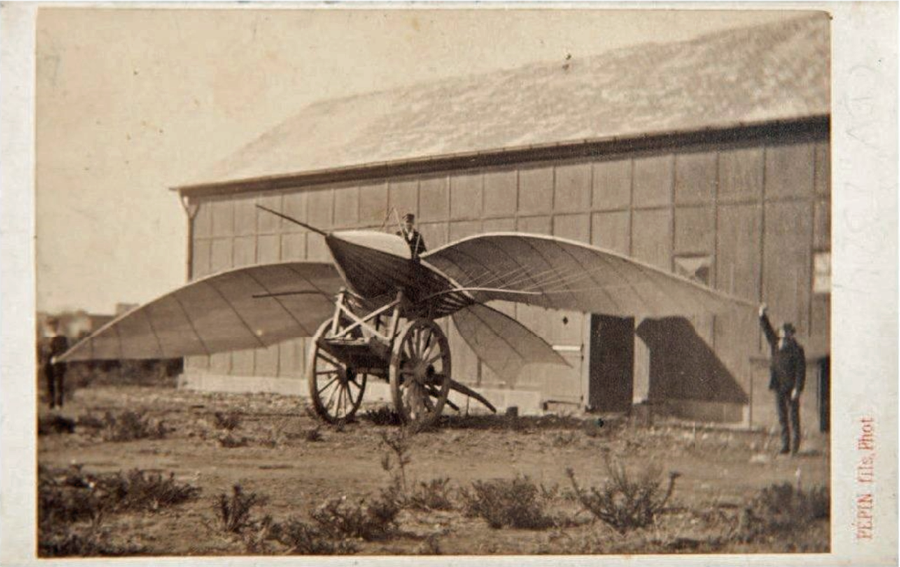
Probably the largest and oldest of which is the full-scale replica of the 1868 Albatross II glider designed by French inventor Jean-Marie Le Bris
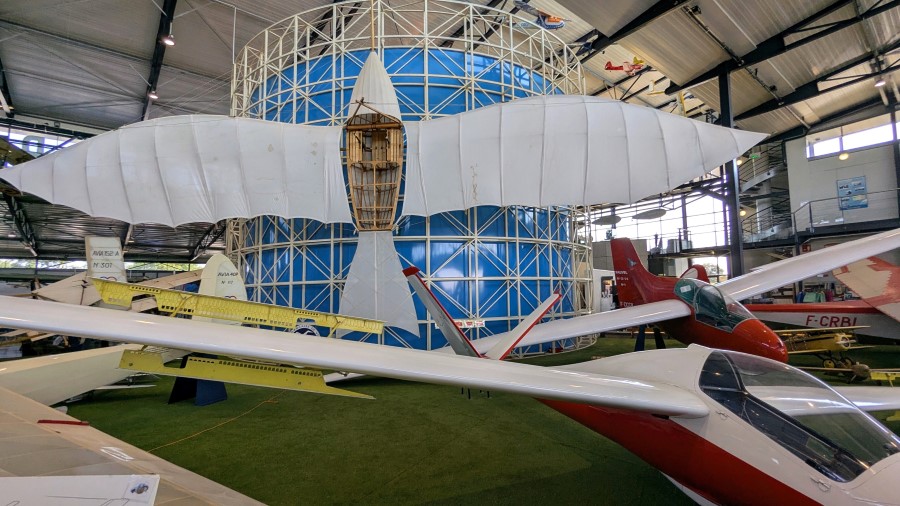
The Albatross II is the one on the wall. Unlikely as it seems, this did fly! More than once. The first version, his Albatros artificiel (it looked very similar) was launched successfully from a cart being towed by horses as fast as possible along the beach and flew for 200 metres. It later crashed, and this was his second version, which also got airborne. The story is here.
I think the graceful DFS Weihe (“Harrier”) sailplane must have looked incredibly futuristic in its day.
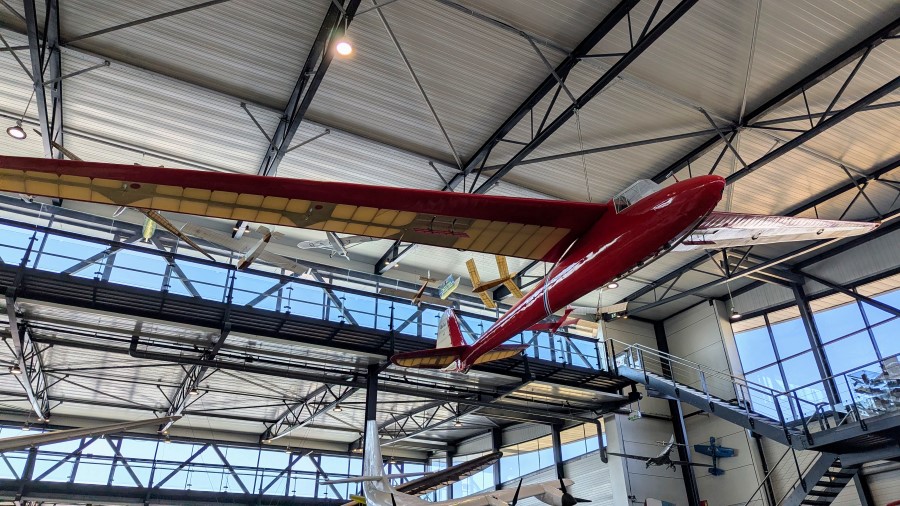
It was designed by Hans Jacobs at DFS (Deutsches Forschungsanstalt für Segelflug, German Research Institute for Soaring Flight) in 1938 and post-war became the standard high performance sailplane in most European countries, setting a number of world records. This one, which was captured in 1945, is one of only three surviving examples, and is one of the museum’s Historic Monuments.
Restoration
The key role of the GPPA* is restoration. Visitors can see into the workshops from the doorways, and go inside on guided tours. Some restorations take years.
A Cessna UC-78 Bobcat dominates the workshop space at the moment.
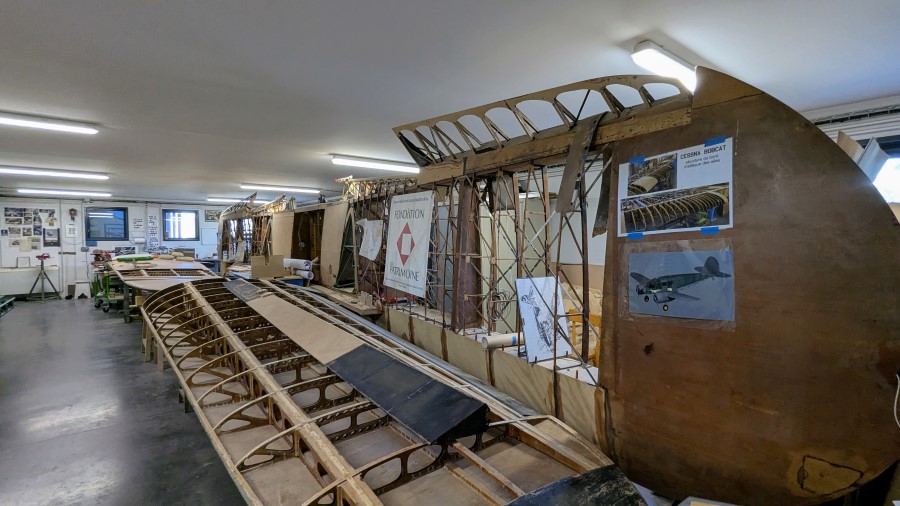
The Bobcat was originally the Cessna T-50 a civilian twin-engine passenger/transport aircraft, first flown in 1939.
When war broke out, the Royal Canadian Air Force and USAAF realised they needed an aircraft to train pilots in multi-engine flying, so Cessna suddenly got orders for hundreds of military trainers designated UC-78. Nearly 5½ thousand were built between 1939 -1944. The Americans called them ‘Bobcats’. The Canadians called them ‘Cranes’. And many B-17, B-25 & B-24 pilots first learned how fly multi-engine aircraft in UC-78s.
Now, says François, there are only four UC-78s in Europe: this one, one in Rotterdam, one in Kraków, and four years ago a team of Germans built one in California and flew it to Bavaria.
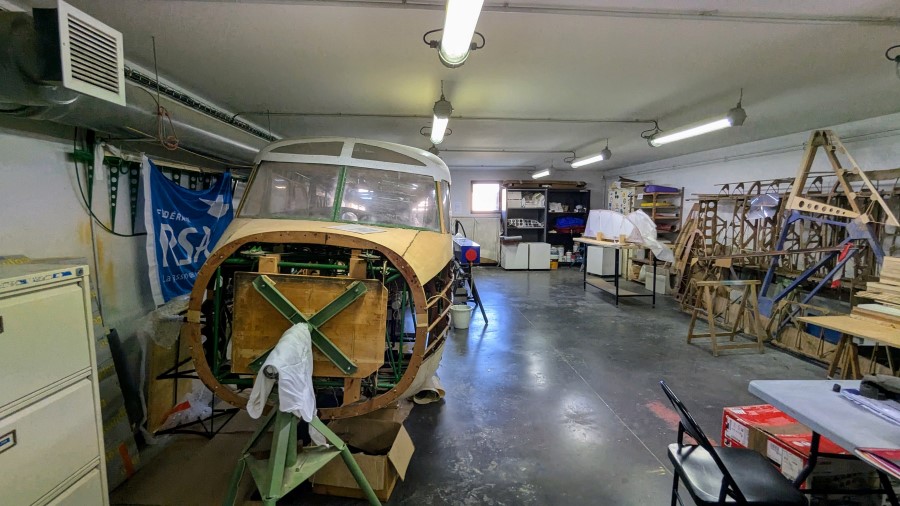
“This one was built in 1943,” says François “We have all the story. It didn’t train any pilots, because it was sent to the US Army in Africa as a transport aircraft. That’s (pointing) the wing of the UC-78. Seven years of restoration, because it was in very bad condition. For the Bobcat, we estimate 14 years to put it in flying condition.”
Events and artefacts
The museum is not just about rare aircraft and restoration. It was renamed Espace Air Passion (from Musée Régional de l’Air) in 2013, because that’s what it is all about; a passion for aviation in whatever form that takes. That’s why there are so many volunteers at the museum helping enthusiasts, schools, families, wannabe pilots and future engineers discover or indulge their passion for aviation.
It might be that their passion is for aviation literature, or films, or art.
This summer the museum held a temporary exhibition: “De l’Air, de l’Art” by painter Joël Rougié, showcasing approximately forty paintings. Some of them focused heavily on aviation themes.
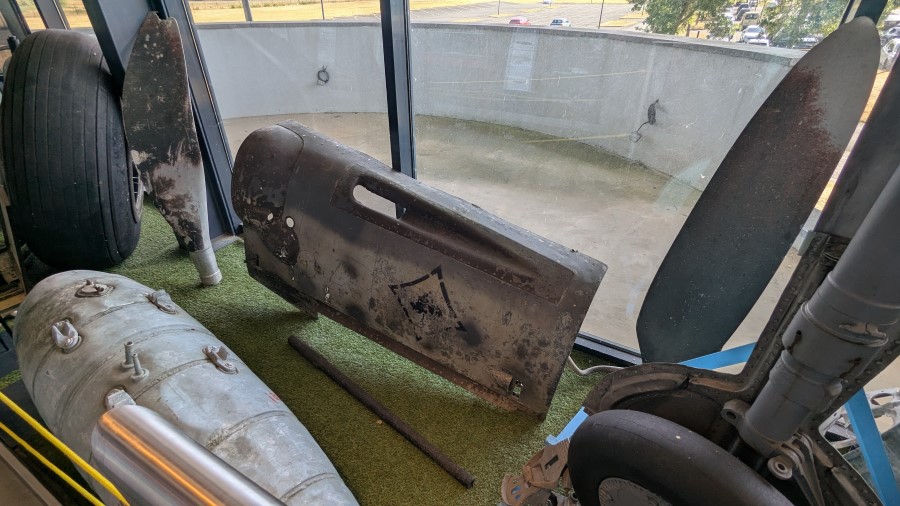
It might be an interest in local war history. Up in the galleries there is a small “wreckology” collection of parts of Allied/Axis warplanes that crashed in the area during WW2.
It might be a love of models. Many of today’s generation of aviation historians developed their interest as kids making plastic models, and one thing you notice in and around all the large exhibits in the museum, are the models. Introduced to the collection in 2004, there are now over 100 scale models on display, some static, some flyable (radio controlled), and some are antiques over 80 years old.
Every year, usually over the Easter weekend, since 2006 the museum has held its ‘Anjou Ailes Maquettes’, an annual gathering and exhibition-competition for flying scale and semi-scale model aircraft.
The museum maintains four flyable powered aircraft and two flyable gliders, although there are 20 aircraft in total (maintained & non-maintained) that are “technically airworthy”… including René Gasnier’s Gasnier III!
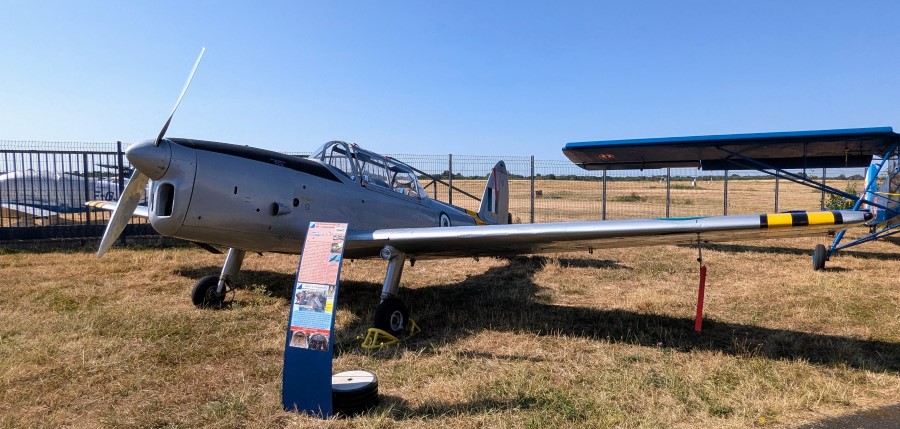
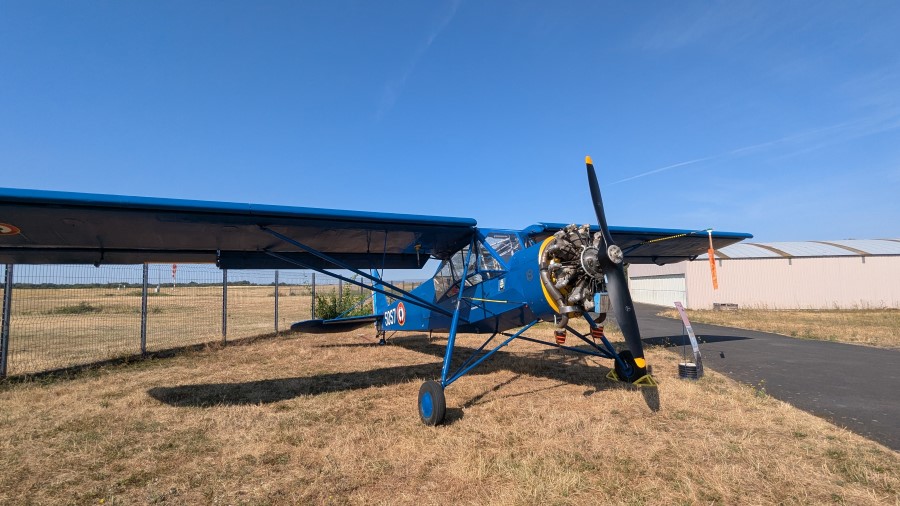
Outside on the apron are three of those airworthy powered aircraft (Swipe left or click arrow for gallery):
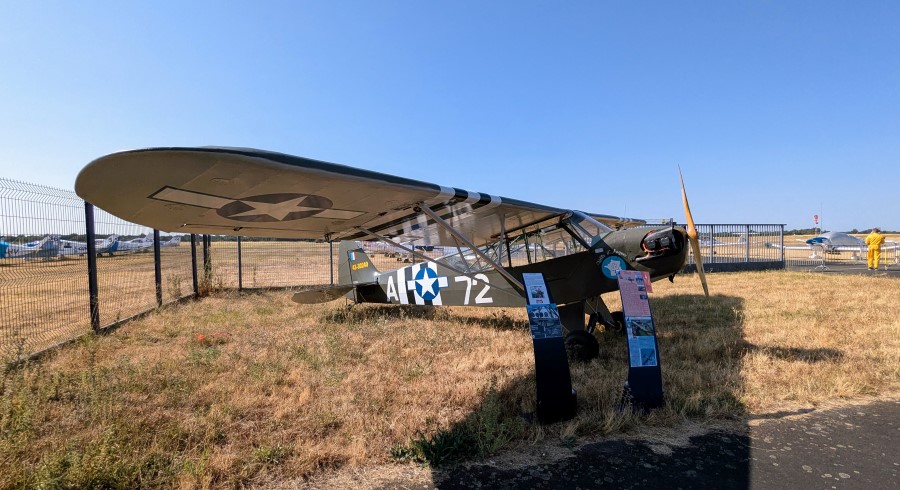
- A Piper L-4H ‘Grasshopper’ used for observation, liaison (carrying military passengers & messages), artillery spotting, medical evacuation, and aerial photography. >This particular L-4H was built in 1944 and served in Normandy, hence the black & white ‘invasion stripes’. It has been painted in the livery of the Piper that, on 24 August 1944, delivered General Leclerc’s message to the Parisian Resistance fighters: “Hold fast, we are coming.”
- The de Havilland DHC-1 Chipmunk was a 2-seat military trainer used by the RAF and RCAF during the Cold War era. Between 1946 – 1956, 1,297 Chipmunks were built. They were easy to fly and responsive, and served in the air forces of 24 countries.
- The Morane-Saulnier MS-505, looks almost identical to the German Short Takeoff & Landing (STOL) Fiesler Storch, the liaison/observation workhorse of the Luftwaffe and Wehrmacht in WW2. That’s because, When France was overrun in 1940, French manufacturers were requisitioned to produce the aircraft for the Germans, which is how the Morane-Saulnier company came to build 141 Storchs. After the Liberation they became MS-500, MS-501, MS-502, or MS-505 depending on the engine installed.
Finally…
Not everything in the collection flew or flies. This bizarre road vehicle is L’Éclair, meaning ‘a lightning flash’, not the pastry!
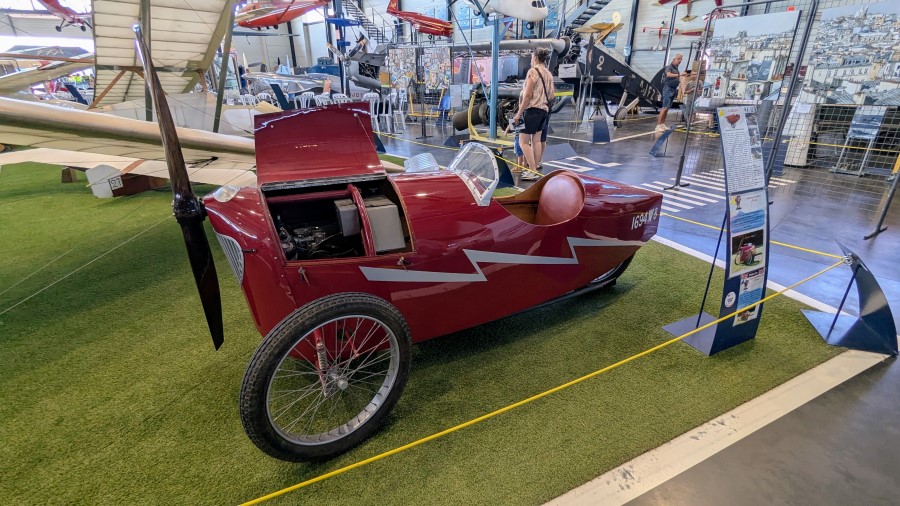
After his military service as an aircraft mechanic, Jean Legeay became a garage owner in Gennes (25 km SE of Angers), and started working secretly on his propeller-driven tricycle in 1926.
It took him two years to finish and start testing it on the local roads! At 100 kph (60 mph) it was faster than anything else and motorists were astonished to be overtaken by what they took to be a very noisy airplane! In 1935, following complaints from locals who saw their chickens and dogs sliced & diced when they strayed into the road (thank God no children!), the authorities unsurprisingly banned him from using it.
L’Éclair was consigned to his attic until 2004, when his son Pierre Legeay donated it to Espace Air Passion.
* Groupement pour la Préservation du Patrimoine Aéronautique (GPPA), created in 1981 by a group of six enthusiasts who managed to rescue a Nord 1300 glider from being burned at a barbecue. They swapped it for some burnable wood and then set about restoring it, the first of many
** You can read all about the extraordinary exploits of the Normandie-Nieman fighter group in Russia, and Lt Andre Moynet’s (Order of the Great Patriotic War, 2nd class) role in John D. Clarke’s book French Eagles, Soviet Heroes. And there is a permanent exhibition dedicated to them at the Air & Space Museum Le Bourget, which is where the group landed back in France at the end of the war. Also, out on the tarmac at Le Bourget you can see the elegant Sud-Aviation Caravelle which he helped develop (and which I flew on several times as a kid).
Declaration: I was on a self-driving research trip. My visit was organised by Destination Angers. Museum entry was complementary.
Factbox
Website:
Musée Espace Air Passion
Getting there:
Angers Loire Airport
49140 Marcé
France
There’s free parking at the site.
Entry Price (2026):
| Adult (18+) | € 8.00 | |
| Reduced rate: under 4 yr olds, students, disabled people | € 4.00 | |
| Family pass (2 adults + 2 – 4 children under 4) | € 20.00 | |
| Under 4s and aircrew in uniform – FREE | ||
Opening Hours (2026):
The museum is generally open in the afternoon on weekends in the winter and all week except Mondays in the summer.
Peak Season: April 13 to October 11
Tuesday to Sunday: 2 p.m to 6 p.m
July & August: Tuesday to Sunday 10.00 – 13.00 & 14.00 – 18.00
Off-peak Season: January 3 to April 12 and October 12 to December 31
Open Saturday and Sunday: 14.00 to 18.00
Closed on Christmas Day and New Year’s Day
Also, check their website because they are sometimes closed for special/private events.
Visiting:
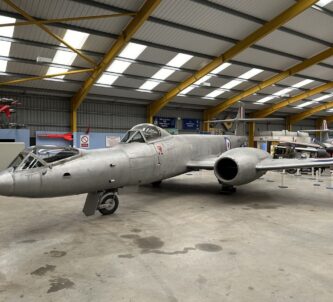
The museum goes to some lengths to attract and engage with kids. They have two military aircraft from the 1950s (a trainer jet and an Army utility plane) that kids (and adults) can climb aboard. They have treasure hunt/learning games, a play area for toddlers, and flight simulators for older kids.
Signage is good but in French, however they have printed guides in English & other languages.
Guided tours are also in French, but they will do a 90min tour in English for groups of 15+. Best to arrange that beforehand.