 By
By Most of Normandy’s D-Day/Battle of Normandy battlefield and memorial sites are both impressive and emotional, but once you get way from the coast and head inland, you begin to find evocative sites that are comparatively unknown and rarely visited.
Here are ten sites, off the beaten path, that I think are particularly poignant and worth visiting.
As you can see, most are conveniently bunched together in/around the Cotentin Peninsula, so you could visit several in one day. I’ve added What3Words locations to each so you can find them precisely. And here’s a thing, while most are not exactly unknown, they are quiet. I have never encountered another D-Day tourist at any of them.
1) Sgt Ashpole Solitary Grave
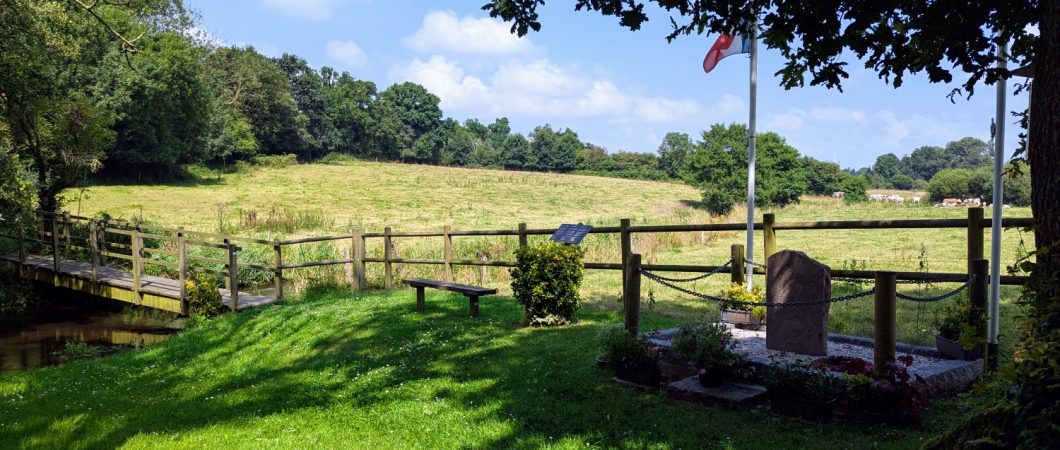
(///complicate.exceedingly.taking)
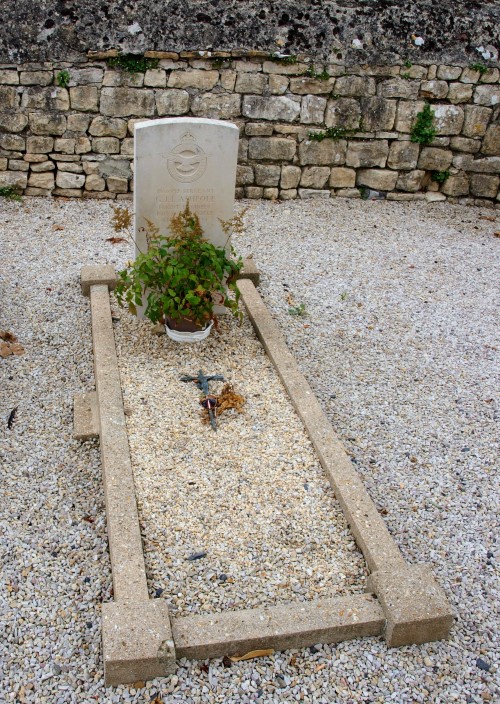
Let’s start with 18-yr-old flight engineer Gerald Ashpole from Gravesend in Kent in his grave in the churchyard in the remote hamlet of Saint-Clément d’Osmanville close to the river Vire.
Gerald and his fellow Canadian and Norwegian crewmates were killed on the night of 6th June (D-Day) when their Lancaster bomber from RAF 97 Pathfinder Squadron, on its way to light up Pointe du Hoc 10 kms away, was shot down nearby.
There is a memorial plaque to the crew* in the churchyard, but his crewmates’ remains were later repatriated… leaving him in a solitary CWGC (Commonwealth War Graves Commission) grave by himself.
Actually, it turns out the one Canadian, Flying Officer William McCutcheon, wasn’t repatriated. His remains were moved to the giant CWGC cemetery in Bayeux. It begs the question, why was Gerald left by himself?
Whatever the answer, I like to visit him when I can and it would be nice if more people dropped by to pay their respects/leave some flowers.
2) Charles N DeGlopper Medal Of Honor Memorial
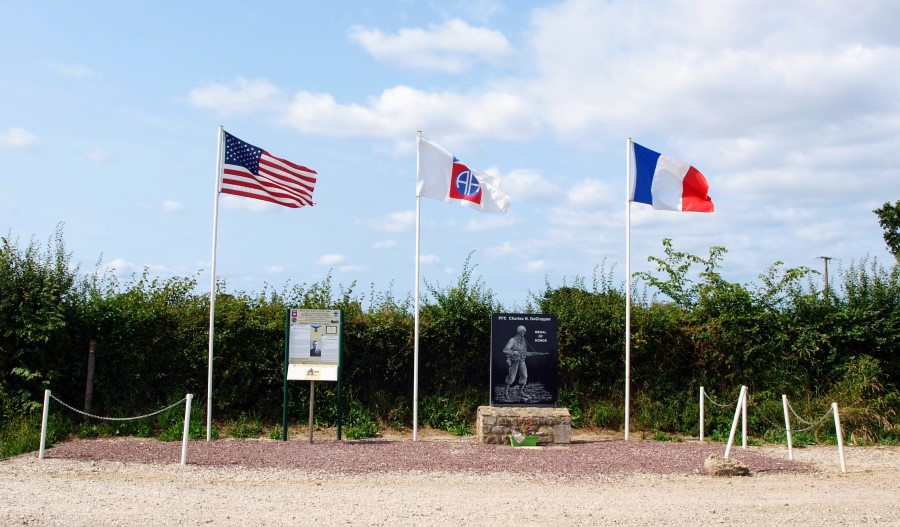
Private First Class Charles DeGlopper from Grand Island, New York, already stood out among his comrades in the 325th Glider Regiment. When he first joined up, they had problems finding a uniform and boots to fit his 2.1m (7ft), 109kg (240lb) frame! It makes you wonder how he squeezed in to a WACO glider cabin (5′ 6″/1.68m at the front, tapering to 5’/1.52m at the back) with 13 other men. I bet he sat at the front!
Aged 22 and having fought in North Africa, he was already a veteran by the time the regiment landed in Normandy. His company was charged with taking the causeway over the Merderet river in the early hours of 9 June, but part of the company got separated in the darkness and stepped out onto the road near this spot to find themselves surrounded on three sides by superior German forces.
While his comrades retreated back through the hedge, DeGlopper began firing his Browning Automatic Rifle (BAR) to draw attention and allow them to escape. He was wounded almost immediately but continued to fire. He was hit a second time but dropped to his knee and continued to fire before eventually succumbing to his wounds.
For his heroic self-sacrifice he was posthumously awarded America’s highest award, the Medal of Honor. Find his story in the Information panels and a tall black stone stèle with an etched image of DeGlopper firing his BAR from the hip. He’s also mentioned elsewhere in the area: inside the nearby Cauquigny Chapel there is an information panel about him, and across the Merderet river there’s a small marker to him in La Fière Memorial Park.
3) Father Maternowski Memorial
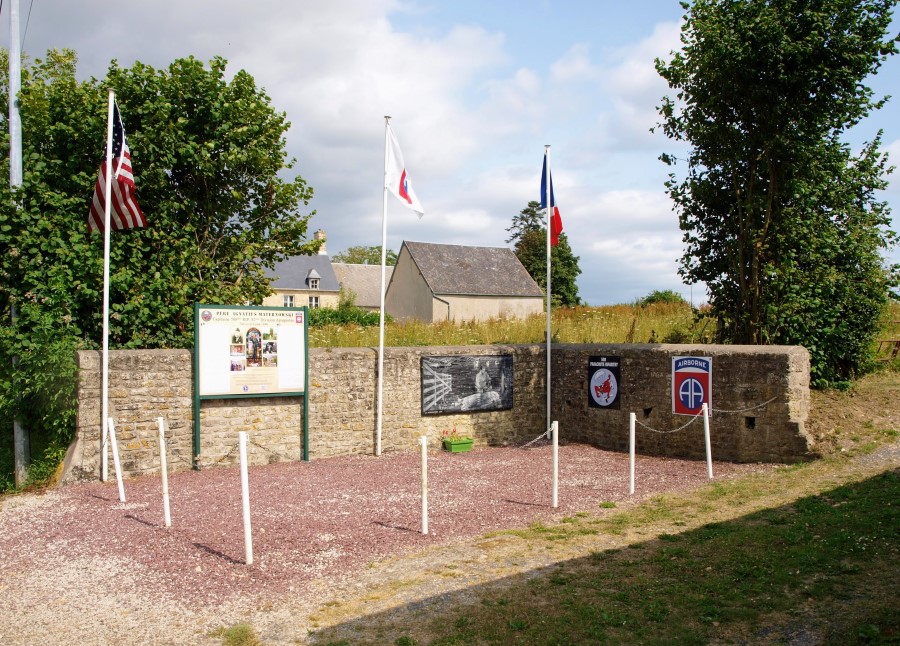
Captain Ingatius P. Maternowski was a catholic chaplain with the 508 Parachute Infantry Regiment (PIR), 82 Airborne Division.
In the early hours of 6 June 1944 many 508th paratroopers were scattered around the small hamlet of Gueutteville, which was garrisoned by German, Georgian and Mongol troops of the 1057th Infantry Regiment, 91st Division. Some paratroopers made their way to a French café/grocery shop to seek directions and pretty quickly wounded paratroopers began to gather here. The café became an aid station and the senior officer, Father Maternowski, showing incredible bravery, set off through the village unarmed to speak to the German commanding officer to ask him to recognise the café and another building as non-combatant medical facilities under the terms of the Geneva Convention.
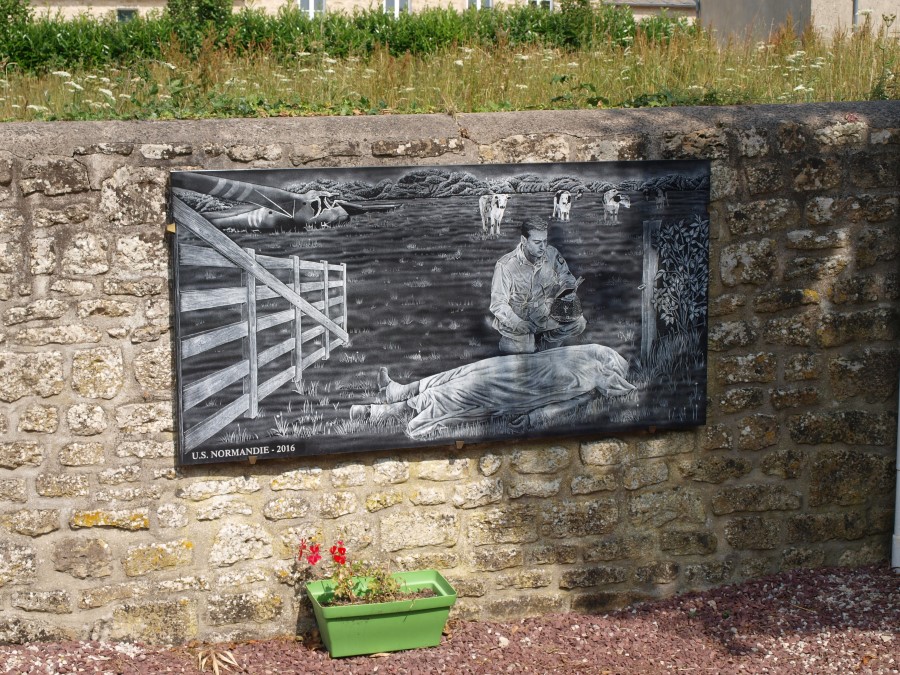
Maternowski giving the
last rites to
a fallen soldier
Amazingly, he wasn’t shot and the German officer returned with him to check the buildings and the condition of the wounded for himself. Afterwards, Father Maternowski escorted the officer back to the upper part of the hamlet, but as he was returning to the aid station, he was shot in the back and killed. It’s not clear whether a sniper shot him, or maybe the officer himself.
This memorial, with its etched image of Father Maternowski giving the last rites to a dying soldier, is located next to the spot on the road where he died.
4) C-47 Memorial Garden
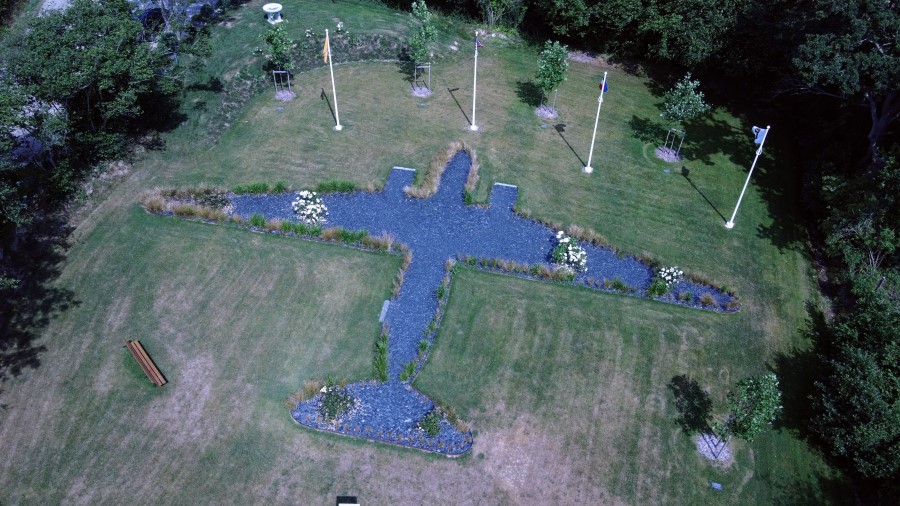
The C47 Memorial Garden outside Picauville marks where a C47 transport aircraft was brought down by flak in the early hours of D-day.
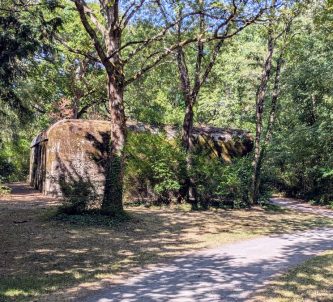
The garden, surrounded by trees, is an idyllic oasis of calm. It’s private land but open to the public. It’s where the C-47 from the USAAF 91st Troop Carrier Squadron, 439th Troop Carrier group, crashed in flames instantly killing the crew of four and its ‘stick’ of 16 paratroopers from 506th PIR, 101st Airborne.
The garden has explanatory stones with maps and details of the aircraft, its route, its crew, and paratroopers. Separately around the garden, individual named plaques lie in the ground in front of sapling trees which have been planted for each crash victim. In the middle, a near-life-size outline of a C-47 is marked out in grey slate with plants growing within its borders. And there are benches to sit on and ponder the sad loss of young lives in a place that gets very few visitors.
Several C-47s were brought down in this area on that night. Nearby, you can see small plaques for two of them at…
- Founecrop (///feed.thankfully.debility) marking the spot where a C-47 of the 77th Troop Carrier Squadron came down on D-Day, killing four crew and 17 paratroopers from G Company, 501st PIR, 101st Airborne Division.
- Clainville (///ignore.cuckoos.recitals) where another 77th Troop Carrier Squadron C-47 fell, killing five crew and 14 paratroopers also from G Company, 501st PIR, 101st Airborne Division, but on this occasion there were three survivors.
5) Battle of Sèves Island Memorial
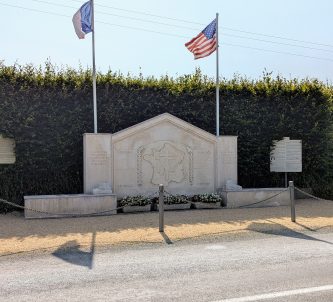
 A tranquil scene now. A fierce battlefield in 1944).
This small stone monument on the bank of the river Sèves is the result of a strange but heartening story.
In the morning of 22 July 1944, the US 358th Infantry Regiment, part of the 90th (“Tough Ombres”**) Infantry Division, tried to assault the villages of Sèves and Saint-Germain-sur-Sèves on the high ground between marshes, called Sèves Island by the Americans. The villages were defended by the elite but battered 6th Fallschirmjäger (Paratroop) Regiment under Major Friedrich August Freiherr von der Heydte.
Later in the day the Germans, led by Staff Sergeant Alexander Uhlig, successfully counter-attacked and then continued the next morning, pushing the Americans back. Losses were high on both sides, but worse for the Americans.
In these fields, after the bloody battle, a small unit of just 44 Fallschirmjäger under Uhlig managed to capture 244 US soldiers, including the battalion commander, Lt. Col. Al Seeger and his staff. Uhlig went to report to Major Von der Heydte at his Battalion HQ and soon found himself having tea with the major and some of the US officers he’d just captured!
Then, at 3.00pm in the afternoon, Von der Heydte was told there were three US Army Chaplains*** carrying no weapons, just Red Cross flags, wandering about in ‘No Man’s Land’ down by the river searching for wounded men. Impressed by their courage, Von der Heydte agreed to a ceasefire so that the dead (100 on the US side) and wounded (500 US soldiers) could be moved.
It’s an astonishing scenario; German and American soldiers collecting their dead & wounded from the same fields. It is reported that at one point a German MG42 machine gunner overlooking the field beckoned to one of the chaplains and directed him to a US soldier who they had missed! He was almost certainly the victim of that same machine-gunner!
This wasn’t the first time that von de Heydte had demonstrated his chivalrous character, and perhaps as a result it’s not surprising that both German and American veterans of the battle for Sèves have met again on this spot for post-war reunions.
If you visit it, you should continue to the 90th Division’s objective, the town of Périers…
6) Les Quatres Braves
(///budgie.divisions.unsubtle)
The fighting for Périers, an important town and crossroads that would help seal off the Cotentin peninsula, was fierce and bloody. There are numerous memorial markers for battles and skirmishes between the Sèves memorial and the town itself.
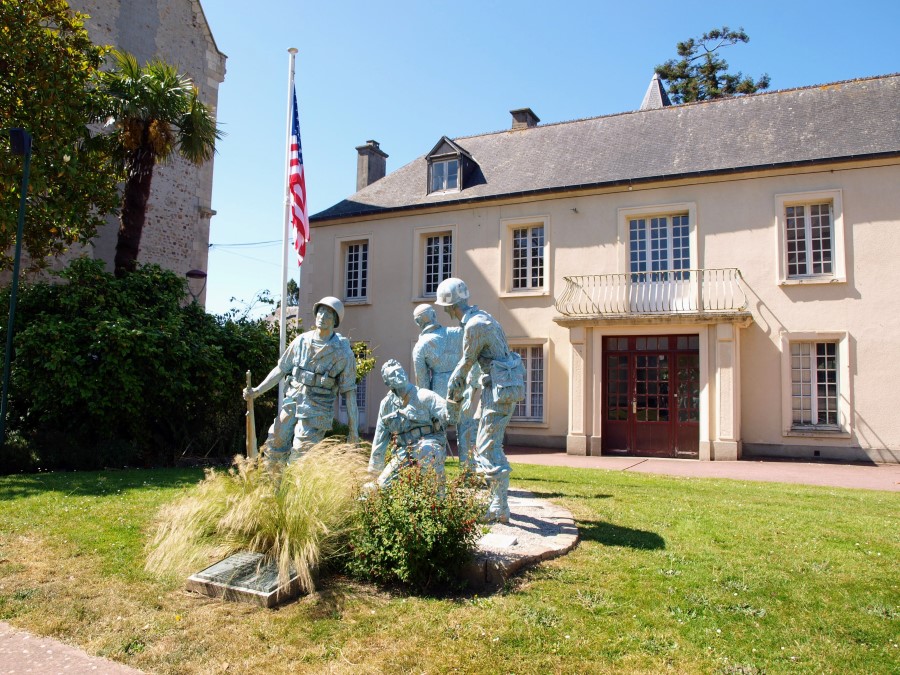
In the centre of Périers, on the grass between the Marie and the Liberation Museum, you’ll find the 90th Infantry Division ‘Tough Ombres’ Monument aka Les Quatres Braves (the four heroes) a liberation monument with four life-size statues of US soldiers.
The four characters depicted were real soldiers in the 90th Infantry Division who died during the liberation of Périers. Their faces are reproduced faithfully by the sculptor Patrick Cottencin.
Private 2nd class Andrew Jackson Speese III is wounded and trying to stand again, aided by a medic, Private 1st class Virgil John Tangborn, who was killed rescuing a driver from his burning truck. Standing guard is Private 2nd class Richard E. Richtman, who was killed on the outskirts of Périers, and the fourth figure is tank commander Staff Sergeant Tullio Micaloni urgently calling his platoon of Sherman tanks forward to assist. On 26 July, Micaloni and his crew literally drew the short straw and were committed to being the first tank to attempt to ford the Sèves to relieve troops on the other side. Just over the river they triggered a stack of anti-tank mines, blowing the tank over and killing all inside. All four of the Tough Ombres are buried in the American Cemetery at Colleville.
If you are looking for a bonus, walk between the buildings behind Les Quatres Braves and into the park. There you will find two memorials nobody ever visits…
- The Col. William McConahey Memorial Tree (///monopolies.subordinate.signs) A small stone with a metal plaque dedicates an ash tree to Colonel MacConahey MD, Battalion Surgeon of the 344th Field Artillery Battalion of 90th Infantry Division. It says that in the midst of chaos he tended to both friend and foe equally.
- US Pilots Kitchens and Espy Memorial (///lynched.freed.describes) A wrecked aero engine and propeller stand on a tall pole among a small copse of trees. On 24 June 1944, a flight of four P-47 Thunderbolts of 508 Squadron, 404 Fighter Group USAAF, were returning to their base in England from a patrol over Avranches when two of the pilots, Bert Espy Jr and Benjamin F. Kitchens, spotted enemy vehicles and peeled off to attack them. Afterwards, as they were manoeuvring to rejoin the flight, they collided and crashed to the ground on the outskirts of Périers, killing both pilots. Some twenty years later the wreck of Espy’s plane was unearthed and on 24 June 2017, 73 years to the day after the crash, the stèle with Espy’s engine and propeller was inaugurated in the presence of Ben Kitchen’s niece.
7) Delbert Schmid Memorial
(///chocolates.restarting.opting)
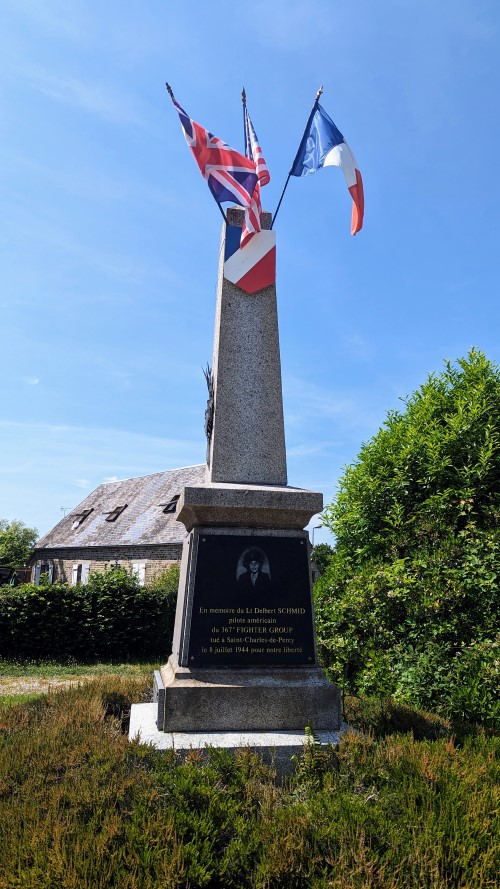
2nd Lt Delbert Emil Schmid from Missouri, was a P-38 Lightning pilot with 392nd Fighter Squadron. He was shot down by flak over Montaigu-les-Bois on 3 July, but bailed out and survived. He was rescued and hidden by locals but five days later they were forced to escape from the front line as it neared. Dressed in civilian clothes, he and a group of locals were killed on the road at Saint Charles de Percy as they tried to evacuate the area.
How did they die? Well, there’s not much information on that.
French civilian eyewitnesses and municipal records in Saint-Charles-de-Percy recorded that on 8 July 1944, a group of local civilians fleeing the combat zone was struck by an air attack (mitraillage aérien) along the road, killing both civilians and the hidden American pilot. But there’s no record of who carried out the attack. So the suspicion is that it was a tragic ‘friendly fire’ incident.
Research published by aviation historians and the 367th Fighter Group Association¹ concluded that because Ninth Air Force fighter-bombers were heavily targeting all road movement in the sector to prevent German troop mobility, low-flying Allied fighters probably mistook the moving civilian column for military traffic. If so, it’s particularly tragic that he should escape with his life when his aircraft was hit, only for him and his French rescuers to be killed by his own side.
Delbert’s memorial plaque is on one side of an obelisk in the churchyard at Saint Charles de Percy. On the other is a tribute to the 21 civilians who died with him.
8)Cpt George Rarey Memorial
(///scholarships.traitor.left)
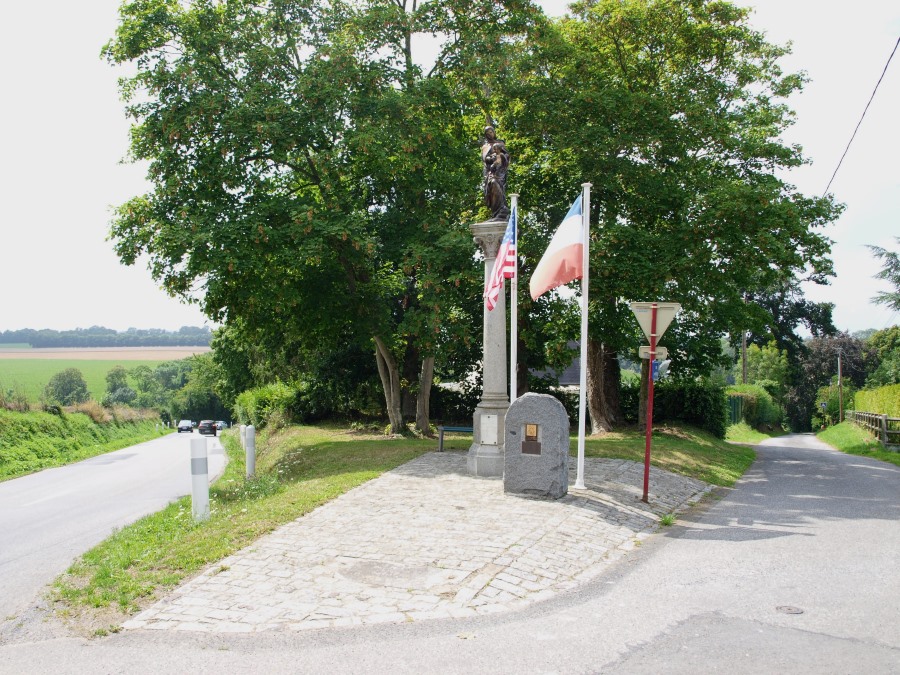
Another American pilot memorial, but there’s something special about this one.
Captain George Rarey, a popular pilot with the 379th Fighter Squadron (P-47 Thunderbolts), was also a cartoonist and commercial artist who painted nose art on up to 30 aircraft in his squadron. He is honoured here with an unusual rough-granite memorial on which, above the formal bronze plaque recording that he died (hit by flak) near this spot on 27 June 1944, is a cartoon of him etched on a copper plate, smoking a pipe and with a pencil tucked behind his ear.
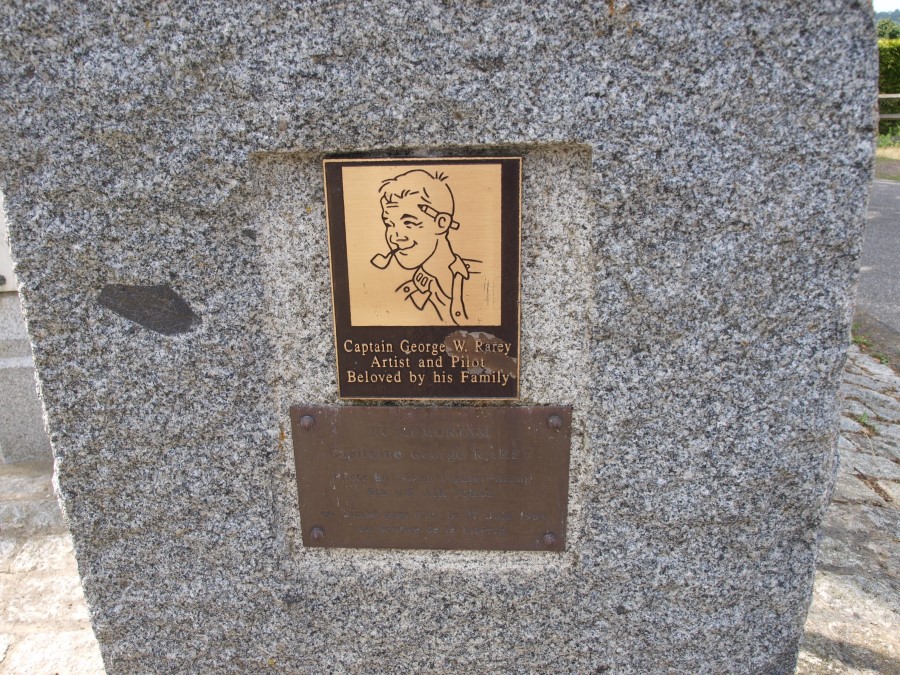
George, nicknamed ‘Dad’ by his comrades due to his age (only 27) drew both funny and serious images of life as a pilot in sketchbooks and on postcards.
And that’s what makes this memorial special. Seeing his self-portrait cartoon brings the man and his sense of humour to life and makes his demise so poignant.
This one is a tricky site to visit. All of the other sites I’ve listed have a layby or car park or somewhere to stop. George’s memorial is on a junction between the busy D67 road and a Sauf Riverains (Locals Only) lane. Your best bet here may be to briefly pull up onto the pavement next to the pink coloured rubbish bins at the start of the junction.
9) Jerusalem Crossroads Memorial
(///exaggerated.dupe.vegetarian)
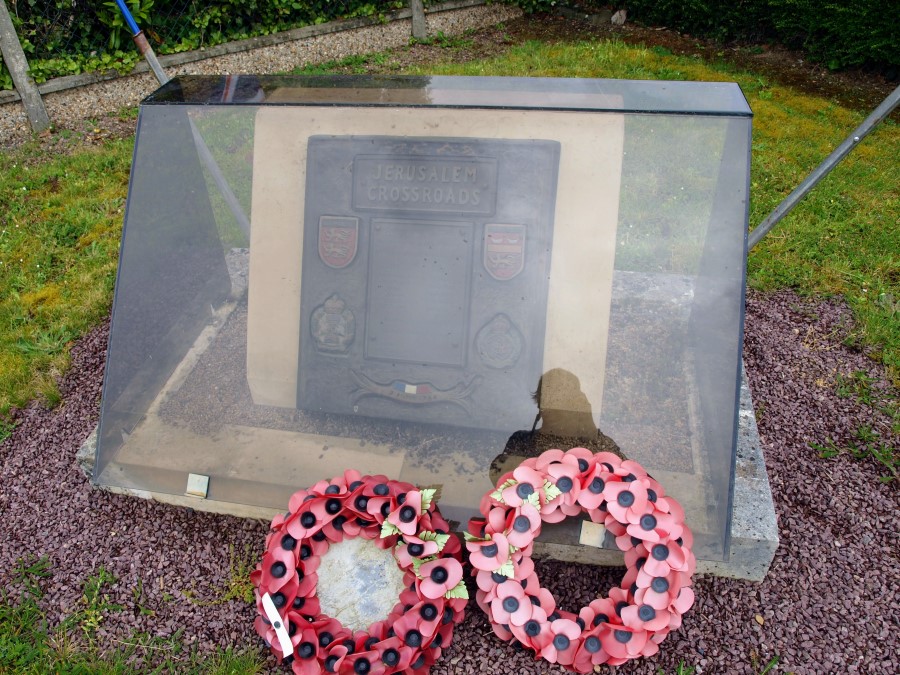
I have a soft spot for the Inns of Court Regiment, aka ‘The Devil’s Own’.
Maybe somebody else had a thing about lawyers, because they were given a shitty job!Their history dates back to the 16th century when members of the legal profession in the City of London were called upon for military duties. But it was King George III, while reviewing his troops in Hyde park in 1803, who, on being told the regiment in front of him was composed of lawyers (for whom he had a passionate dislike), directed they be named “The Devil’s Own”!
By WW2 they had become a light tank cavalry regiment and on D-Day, C Squadron of the Inns of Court Regiment were attached to the 3rd Canadian Infantry Division, landing on Juno 30 minutes after the first wave. There is a marker just behind the beach where they landed at ///turtles.dragged.gridded.
Maybe somebody else had a thing about lawyers, because they were given a shitty job!
Their almost impossible mission was to race ahead in their armoured cars paired with teams of Royal Engineers in half-tracks filled with explosives, up to 50km behind enemy lines to blow up the main crossings along the River Orne south of Caen.
Despite a heroic attempt, their small unit was whittled down, by German opposition and Allied friendly fire, to the point when they were withdrawn.
The crossroads at the village of Jerusalem was where they were shot up by an American P47 Thunderbolt. After its first pass they laid out yellow identification panels and fired yellow smoke flares, but the aircraft returned for a low-level strafing and bombing run. This time it hit a RE half-track which detonated with massive force, destroying the vehicle, flattening nearby buildings, damaging their other vehicles and killing six of their soldiers****. There’s a small stone plaque on the ground at the crossroads remembering the soldiers and five civilians who were killed, but it is unfortunately covered with a smoked Perspex screen making it almost impossible to read.
You’d expect the soldiers to be buried in the Jerusalem CWGC Cemetery just 525 metres down the road, but they are not. The tiny Jerusalem CWCG cemetery (worth a visit) was dug for the dead from a battle in nearby Tilly-sur-Seulles on 9 June. It seems the victims of the Jerusalem crossroads attack were so obliterated there was nothing left to bury. The CWGC have no records for them.
10) Moissy Ford
(///subtracting.reattach.lifeboat)
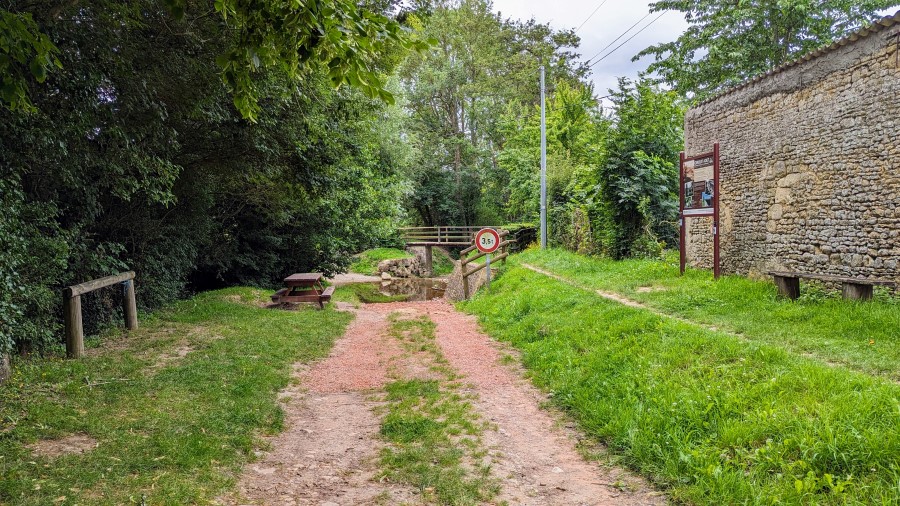
This, I think, is the most poignant of them all.
Around 19 Aug 1944, this tranquil little spot, nestled among the trees with a little picnic table next to the stream, was a scene of total bloody carnage and panic as the remnants of Von Kluge’s German army sought to escape the firestorm through the Falaise Gap. Traffic was snarled up, vehicles and equipment were abandoned, and Germans fought each other as they frantically tried to get across almost the last crossing point of the Dives river while Allied aircraft and artillery were mercilessly bombarding them.
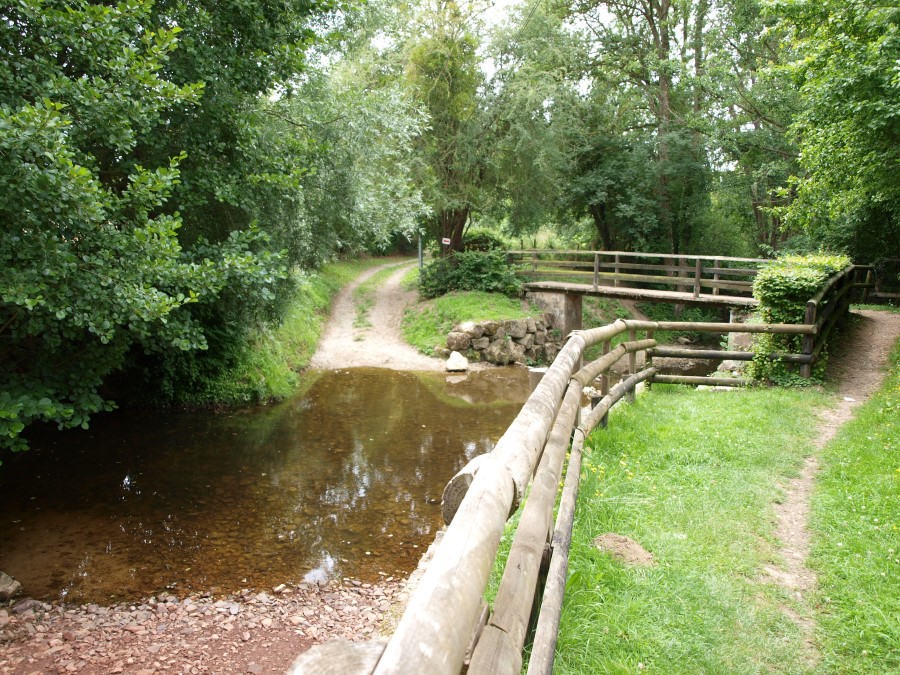
It became known as the ‘Corridor of Death’ for good reason. Dead horses and men were piled up with the wreckage of their equipment in the lanes on both sides of the ford.
There’s an info board on the wall of the adjacent stone barn with photos of the carnage that you can peruse while enjoying the peace and quiet of this picturesque little spot. It’s hard to imaging such scenes here, 82 years later.
If you have your own ‘most poignant site’, you can add it in the comments for everyone to see.
* Gerald’s crewmates were: Løytnant Finn Varde JESPERSEN (pilot); F/O William Robert McCUTCHEON; Sersjant Herlof John Ernst EVENSEN; Sersjant Knut BAADE MAGNUS; Sersjant Christian MÜNSTER; and Sersjant Kåre PEDERSEN
** The 90th Division was formed with men from Texas and Oklahoma. Their insignia was the letters TO so they became known as Tough Ombres.
*** Catholic Father Joseph J. Esser, Salvation Army Chaplain Edgar H. Stohler and Disciples of Christ Pastor James M. Hamilton.
**** Lieut. Ian Gwynne-Jones, Lieut. D.W lofts RE, Trooper R Gillies, Trooper H Simpson, Sapper J.B.C Mac Taggart, Sapper C.G Boynton
¹ Friends of the New Forest Airfields (FONFA). “2nd Lt. Delbert E. Schmid.” 367th Fighter Group Newsletter, no. 19 (May 2026).